FIFO Chef Jobs
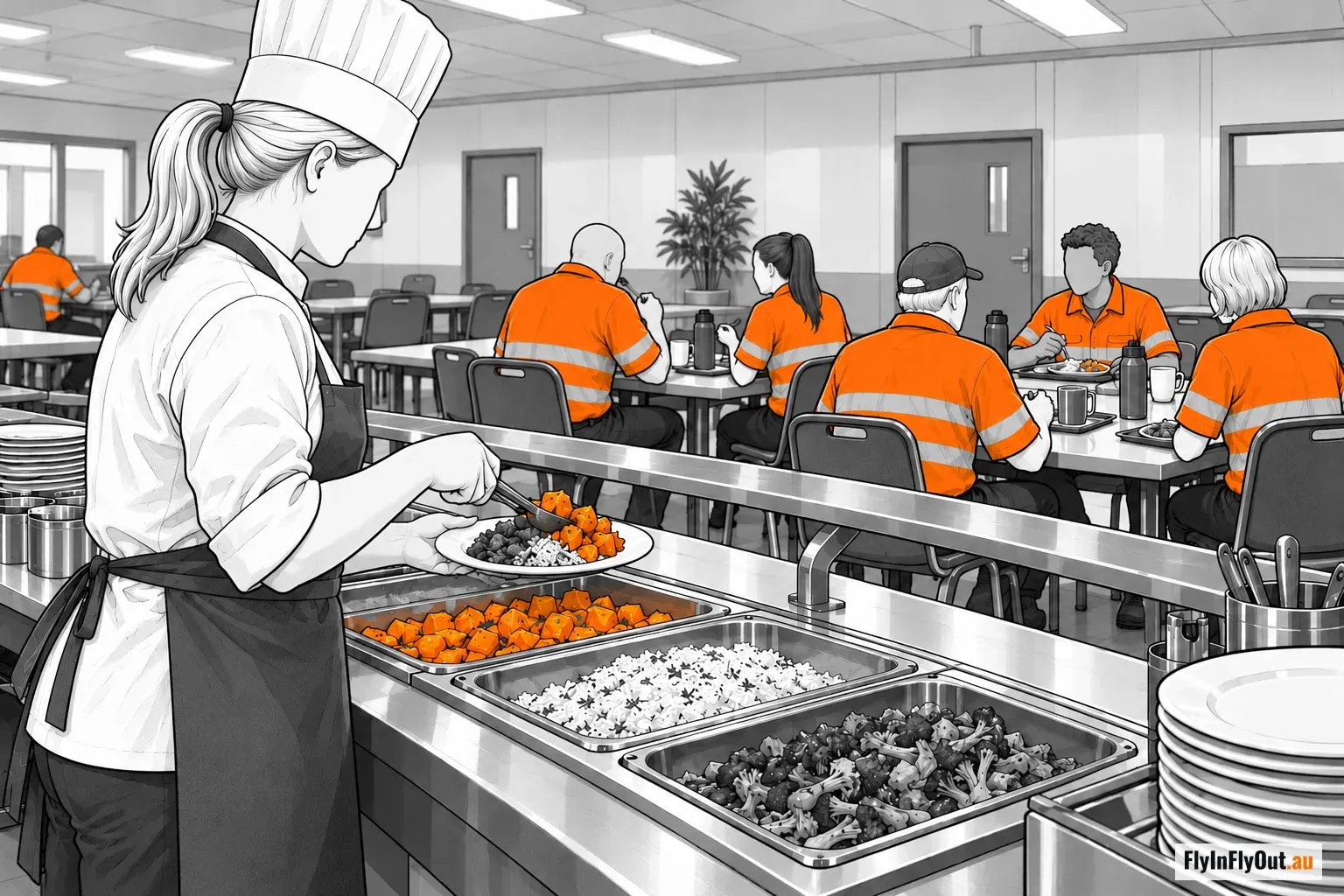
FIFO chef jobs are a different kind of kitchen job. Instead of a handful of diners on a Friday night, you might be feeding hundreds of workers, three meals a day, for an entire swing: the block of days you spend on site before you fly home. The shifts run up to twelve hours and the volume never lets up, but the money is solid, your food and room are covered, and you get blocks of time off that most city chefs never see. It's a good trade if you're worn out by late nights and don't mind management having a big say in what you can cook.
What a FIFO chef is
A FIFO chef cooks for the workers at a remote mine camp, flying in for a swing and home again. The cooking is bulk, to a set menu, served hot from a buffet counter. The kitchen ranks like any other, from cooks and junior chefs up to a head chef.
FIFO chef jobs: Where to start
- Qualified chef or cookStart here
- No cookery qualificationStart here
- Hotel or overseas experienceStart here
- Trade papers from years agoStart here
- Living interstate or in New ZealandStart here
Find FIFO chef jobs
The live ads are on SEEK (opens in a new tab), Jora (opens in a new tab) and Indeed (opens in a new tab), and the caterers and agencies don't all post in the same place. The titles vary, so search FIFO cook, camp chef, sous chef and head chef as well.
Before you apply, check where each ad's flights leave from, called the point of hire. Getting there is usually up to you.
FIFO chef jobs at a glance
| Pay | $86,000 to $115,000 a year full-time; $43 to $70 an hour casual |
|---|---|
| Rosters | 2:1 (two weeks on, one off), 8:6, 7:7 or 14:14; ten to twelve-hour shifts, early starts |
| Flies from | Mostly Perth; Brisbane, Sydney, Mackay, Townsville, Cairns, Adelaide or Darwin for camps outside WA |
| You'll need | A cookery trade certificate (Cert III), Food Safety Supervisor, police clearance, White Card, first aid |
| Experience | High-volume cooking; most agency ads also want three months to a year as a FIFO chef in Australia |
| Who hires | Camp caterers such as Sodexo, Compass Group (ESS), Civeo, ISS and Cater Care, and labour hire agencies |
Pay from the job ads of 12 October 2026. Listings checked October 2026.
Can I become a FIFO chef?
Short answer
You can become a FIFO chef if you're qualified to cook. Camp kitchens are trade kitchens, and the paperwork they want is ordinary trade paperwork.
How do I get a FIFO chef job?
Short answer
You get a FIFO chef job mostly through the camp caterers and the labour hire agencies, because mining companies usually contract out their camp kitchens. A few run their own kitchens and fill their chef positions direct.
Get your tickets current first. A ticket is any qualification, certificate or licence you hold, and sites want all of yours in date before you apply, not after. What the common ones cost is on FIFO tickets.
Apply to the caterers and the agencies, not just to job boards. The big camp caterers (Sodexo, ESS, Civeo, Cater Care and others) run their own recruitment. Labour hire agencies, which employ you and send you to whichever site needs cover, fill the casual and relief roles. Who's hiring and where to send it is on the resource list, and it's worth registering with several agencies rather than one.
If you haven't cooked on a FIFO site yet, look for the ads that say they'll take someone new to FIFO. In October 2026, Cater Care and IronMerge both did.
Step by step, as a qualified cook in WA
- Have your cookery trade certificate ready. If you trained in a hotel or overseas, get that training recognised as the Australian certificate before you apply (getting it recognised).
- Get your Food Safety Supervisor ticket, CPR and first aid, a White Card and a police clearance, and keep each one in date (what they cost). Every course asks for your USI (Unique Student Identifier), a free number you make online.
- Get a Perth address before you apply to the WA camps, which hire their cooks out of Perth (if you live interstate).
- Rewrite your résumé for a camp recruiter, leading with the numbers you cooked for and the food safety records you kept (how to word it).
- Apply to several camp caterers and agencies in the same week, starting with the ads that take cooks new to FIFO (who's hiring).
- Never pay an agency or anyone else to put you forward for a job (the fee rule).
- Once you're offered the job, the employer books the medical and drug test and the inductions, then your flights.
- On your first swing, expect a 4am start, bulk cooking from a menu that repeats, and hundreds of hungry workers at each service (a typical day).
Outside WA
Outside WA, the camps fly their cooks from the hub nearest them, such as Brisbane or Mackay for the Queensland coal camps, Adelaide for Olympic Dam and Darwin for the Territory's mines (where chefs fly from).
I have years of hotel or overseas experience. Why do I keep getting knocked back?
Chefs with hotel or overseas experience usually get knocked back for no Australian address, overseas papers not recognised here, or a résumé written for à la carte. A recruiter reads an overseas address as a flight to pay for, and a training college can turn your experience into the Australian certificate through recognition of prior learning (RPL). Fix the address and the papers before you apply, then rewrite the résumé.
The résumé costs nothing to fix. You translate your experience into camp language, because a camp recruiter is reading for volume, consistency and food safety.
| Instead of | Write |
|---|---|
| Chef, Perth restaurant | Produced meals for 400-person functions |
| Breakfast chef | Ran a high-volume breakfast service |
| Kitchen duties as required | Responsible for food safety records and stock control |
They're the same jobs, but only one version is readable to the person deciding.
Getting your papers recognised in Perth
With RPL, an assessor checks your work history against the cookery certificate instead of putting you through the course. Start with TAFE, the state-run training college: North Metropolitan TAFE in Joondalup charges half the usual fees for RPL, keeps your enrolment open for six to twelve months, and refunds nothing if you fall short.
The certificate is fee-free at TAFE for WA residents who meet the conditions, so ask what you'd pay before you start. If you've cooked for years without an apprenticeship, ask about Trade Skills Recognition, the RPL route to a trade certificate, which WA's Apprenticeship Office approves. A private college costs more: Stanley College in West Perth listed RPL at $150 to $250 a unit in October 2026, and the certificate has 25 units.
The cookery certificate includes the two Food Safety Supervisor units, but under the national food standards the supervisor's certificate has to be less than five years old. If yours is older, North Metropolitan TAFE runs the one-day course in Joondalup for $81, for people already working with food (October 2026).
Once you're offered a job
Once you're offered a role, expect a pre-employment medical, a drug and alcohol test, and online and on-site inductions before your flights are booked.
Where fly in fly out chefs fly from
Most FIFO chef jobs fly from Perth, because Western Australia has the most mines too far from a town for workers to drive home each night.
| State | Main FIFO areas | Usual fly-out city |
|---|---|---|
| Western Australia | The Pilbara (iron ore, around Karratha, Port Hedland and Newman) and the Goldfields (gold and nickel, around Kalgoorlie) | Perth |
| Queensland | The Bowen Basin (coal, inland from Mackay) and the north-west around Mount Isa | Brisbane, plus Mackay, Townsville and Cairns |
| South Australia | Olympic Dam and the outback | Adelaide |
| Northern Territory | Remote mines such as McArthur River | Darwin |
How much do FIFO chefs get paid?
Short answer
FIFO chef ads in October 2026 offered $86,000 to $115,000 a year for full-time work. Casual chefs were advertised at $43 to $70 an hour, with more for night shifts and public holidays in some ads. The bigger salary comes mostly from working more hours, not from a better hourly rate.
| Role | Advertised pay | Source |
|---|---|---|
| Lowest hourly ad | $43 – $59 per hour | SEEK, TCLH, October 2026 |
| Highest hourly ad | $43.5 - $70 per hour | SEEK, Evolve Talent, October 2026 |
| Lowest day rate ad | $437.54 a day | Indeed, Compass Group, October 2026 |
| Highest day rate ad | Daily pay rate: $ 503.63 + Super + Allowances | SEEK, Compass Group, October 2026 |
| Lowest salaried ad | $86,000 – $96,000 per year | SEEK, Sodexo, October 2026 |
| Highest salaried ad | Annualised wage from $100,000 - $115,000 | SEEK, ISS, October 2026 |
The bottom and top ad of each kind, from 20 job ads of 12 October 2026; the middle hourly figure is $48 an hour, and the middle salary is $100,050 a year. Only ads that stated a figure are in the table. Most don't.
Every one of these moves with the employer, the roster, the region and the contract. To see what any of them comes to after tax, over a swing or a year, put it into the FIFO pay calculator.
Casual and agency work is its own arrangement. Casual means no fixed roster and no paid leave, and the agency is the company that employs you and hires you out to sites. The hourly rate is better than the equivalent hour on a salaried roster, but you only earn when there's a placement, and placements don't arrive on a schedule.
Some chefs build a year out of it deliberately. Others find the gaps harder than the shifts.
A first-year FIFO chef can save more than in a city job, but less than the salary suggests, because home costs keep running while you're away. On site you spend almost nothing: no rent, no groceries, no fuel, no takeaway. Chefs who save are usually the ones who kept their city costs low before they started, and on casual work the gaps between placements earn nothing.
What does a FIFO chef do?
What the camp looks like
You're not flying to a mine, exactly. You're flying to a camp, also called a village, that exists to house and feed the people who work at one.
The kitchen is large, usually air-conditioned and built for bulk. It has walk-in cool rooms, big ovens and tilting pans (large flat cooking vessels that tip up to pour out), all sized for hundreds of portions at once.
Where everyone eats
The mess is the dining hall. It's also called the dry mess, because no alcohol is served there. It's a self-serve buffet with trays, and there are no waiters and no table service.
The crib room is where workers make up their crib from what the kitchen sets out.
The bar and your room
The wet mess is the camp bar, where alcohol is served under strict limits. It's not your kitchen and usually not your job, but you'll hear the name daily.
Your room is a private room in the village, yours for the swing.
A typical day for a FIFO chef
You cook in bulk, for hundreds of workers a service, through steam wells and bain-maries. A steam well is a hot water bath that holds trays of food at temperature; a bain-marie is the serving version of the same idea, the heated counter the food sits in while people help themselves.
The menu is set and it repeats on a cycle. The recipes are written down and so are the portion sizes. There's no à la carte and no orders coming in one at a time. Instead there's a production schedule: this many people, this much food, ready by this hour, made safely and the same way it was made last cycle.
The person you're cooking for has just finished twelve hours in forty-five-degree heat. They are not looking at the garnish. They want the steak not overcooked and they want there to be enough of it, and if there isn't, you'll hear about it.
Shifts, and who's who in the kitchen
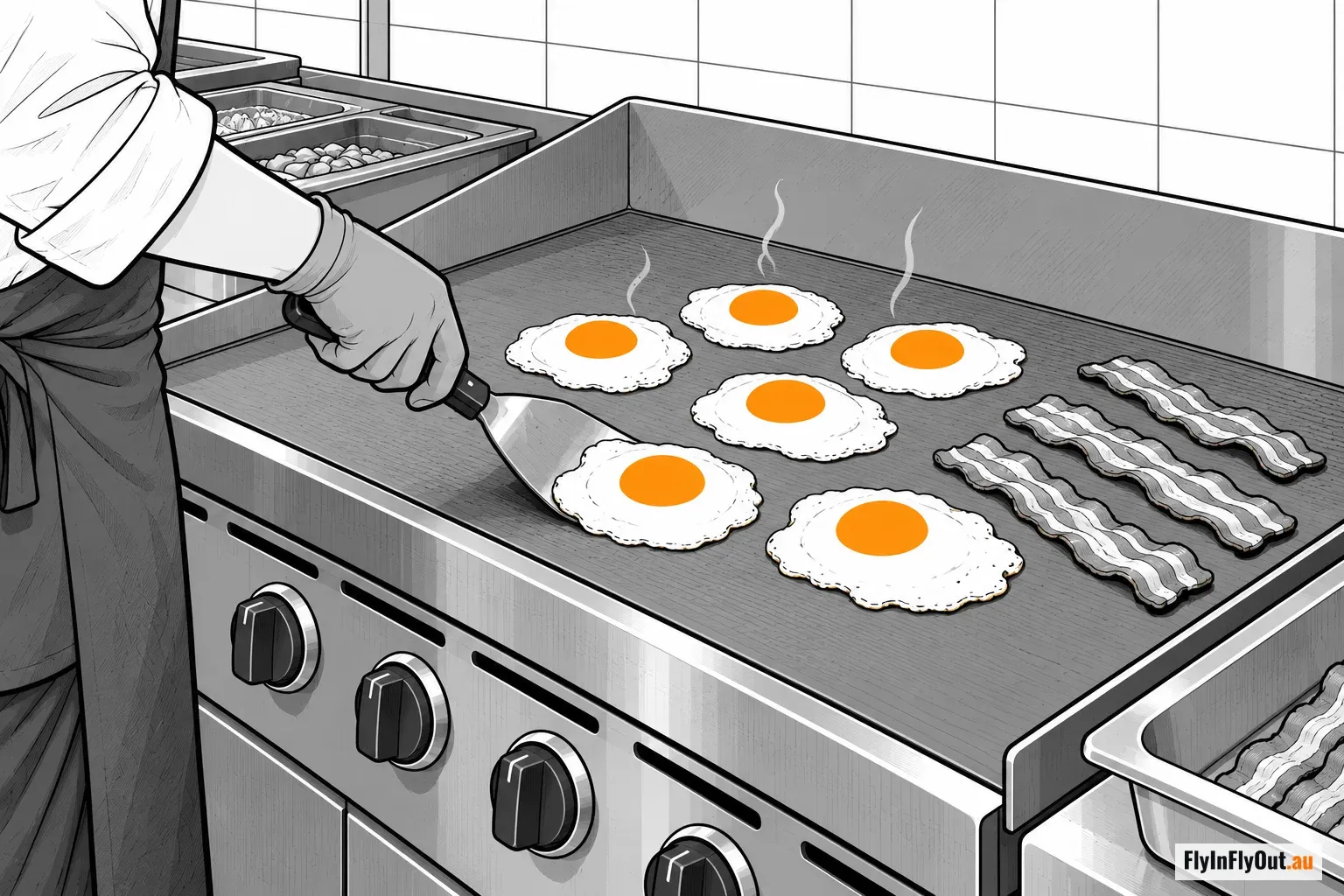
Which shift you're on decides what you cook. Breakfast starts before dawn, doing hot breakfasts and setting up the crib supplies. Crib is the packed lunch workers take out on shift, and the kitchen lays out what goes into it. Day shift is mostly bulk preparation for dinner: roasting, curries, setting up the steam wells, and the ordering.
The kitchen ranks the way any kitchen ranks, just at a bigger scale. Cooks and commis (the junior chefs) do the batch cooking and work the stoves and grills. A sous chef or senior chef runs the shift, keeps the stock in date and supervises the utility staff, who wash up and clean.
The head chef runs ordering, budgets, food safety compliance and supervision. Above that a catering or camp services manager runs the whole village, kitchen and cleaning and bar together.
The roster
A 2:1 roster means two weeks on and one at home, and a 14:7 is the same roster written another way, so an ad using one is not offering something different from an ad using the other.
Even time, where your days off match your days on, is worth asking about, and worth more than most people realise when they're comparing offers. One week home in three is a different life from half your year at home.
The hours, and the early finish
Fourteen twelve-hour shifts is 168 hours in a swing. A city chef on a 38-hour week works about 114 hours in the same three weeks. That gap is the number to hold in your head when you compare a camp salary against a city one.
One difference stands out straight away: the finish time. You're done in the afternoon, not at midnight or at one in the morning with the floor still to mop. What you do with that time is up to you, and on a camp the options are a gym, your room, a walk and the wet mess.
What do you give up as a FIFO chef?
You give up the craft, mostly.
You cook to set recipes, to SOPs, which are standard operating procedures, the written step by step the company wants followed every time, and to a food budget set per head. Menu choice isn't yours. Ingredient choice isn't yours either, and what arrives is often frozen, bulk or pre-cut. The part of cooking that is about your own dishes goes behind a steam well and stays there.
Tips go, because nobody tips in a mess. So does the thanks. Nobody walks out of a dining hall saying compliments to the chef. They walk out saying nothing, or they walk out saying the eggs were cold.
Why camp food is what it is
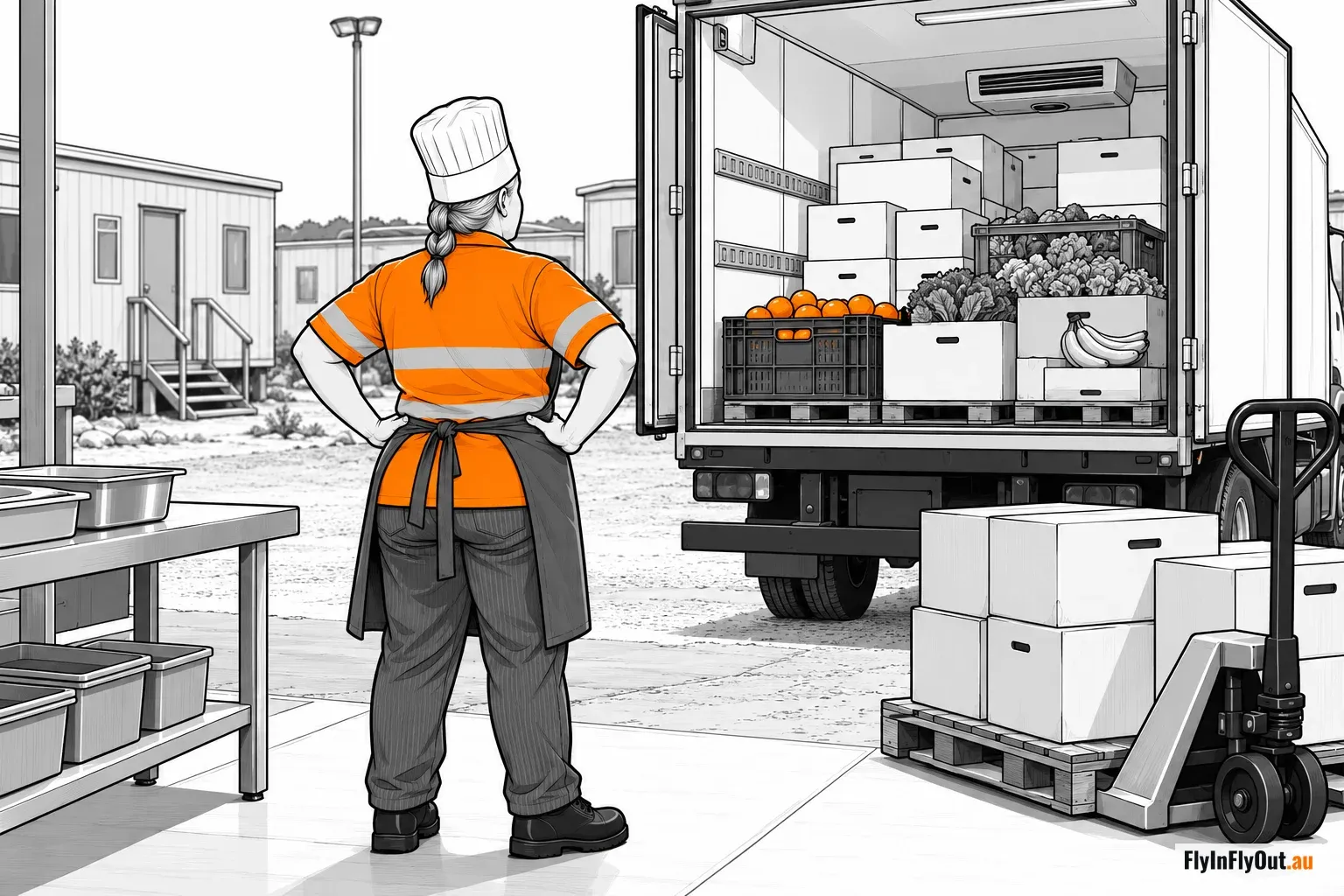
It helps to know why the food is what it is before you're standing in front of a pallet of frozen vegetables wondering what happened to the produce order.
Camp catering contracts are won by tender, which means the mining company invites caterers to bid and usually takes a low bid that can do the job, so caterers compete hard on price. The savings that win a contract come out of the food budget and the wages. The contract then sets what can be spent per person per day, and what reaches the kitchen is whatever that number buys.
That puts the kitchen in the middle of it. The people eating blame the cooks for food that isn't what they'd get in town, and the cooks are working to a budget they didn't set with ingredients they didn't pick. There's a joke that goes around the forums about camp cooks being magicians, because they can put anything at all into a pot and still have it come out inedible.
Is being a FIFO chef worth it?
Short answer
Being a FIFO chef is a trade-off: you give up creativity, menu control, your choice of ingredients, tips and any thanks from the people you feed. You get back steady money, a finish time in the afternoon, covered living costs on site and time off in blocks. Which half matters more to you is the whole question.
Ask people who've cooked on a camp and you'll hear two very different answers. They're both right, because they're comparing the job with different things.
Compared with the trades on site
Next to the tradespeople and machine operators you're feeding, camp cooking pays less, and the people who've done it don't sugar-coat that. One chef, whose dad was drilling in the 1970s, wrote online that cooking has been among the worst-paid work on site ever since, and always will be.
A head chef who left after thirty years, to fix conveyor belts for a labour hire company, called it a thankless trade.
Compared with a city kitchen
Next to a city kitchen, the camp job looks better. Your hours are locked in, so nobody sends you home early on a quiet Tuesday. You finish in the afternoon. And some workers use the job as a way into the rest of the site.
One cook wrote online that the trick is to get to know the blokes you feed, especially on smaller camps, and jump across to driving trucks or operating machines as a green start. A green start is someone taken on with no site experience and trained from scratch.
Three honest questions
- Is it the late nights you're tired of, or the cooking? A camp kitchen fixes the hours and keeps you cooking. If cooking itself is what's worn you down, a different job will fix it and this one won't.
- Can you cook someone else's menu, to someone else's budget, every day? If what you care about most is what goes on the plate, a camp will frustrate you, because the menu, the budget and the ingredients aren't yours.
- Will you be comparing your pay with the trades? They earn more, and you'll be feeding them three times a day. If you want a way into mining work, though, the camp puts you on site, where you meet the people who hire.
So the question isn't whether this work is good. It's what you're comparing it with, and which half of the trade you'd miss more.
Ready to look?
If you've read this far and still want in, the jobs are here. Sort your tickets first, then apply to several at once.
- FIFO chef jobs on SEEK (opens in a new tab)
- FIFO chef jobs on Jora (opens in a new tab)
- FIFO chef jobs on Indeed (opens in a new tab)
- All job boards, contractors and agencies in one list
Fake ads turn up on real job boards too. An ad that asks you to pay a fee before you start is a warning sign: report it to Scamwatch (opens in a new tab).
Still not sure which chef you are? Six questions. Three minutes. Free.
Is FIFO right for me?