What Is a USI?
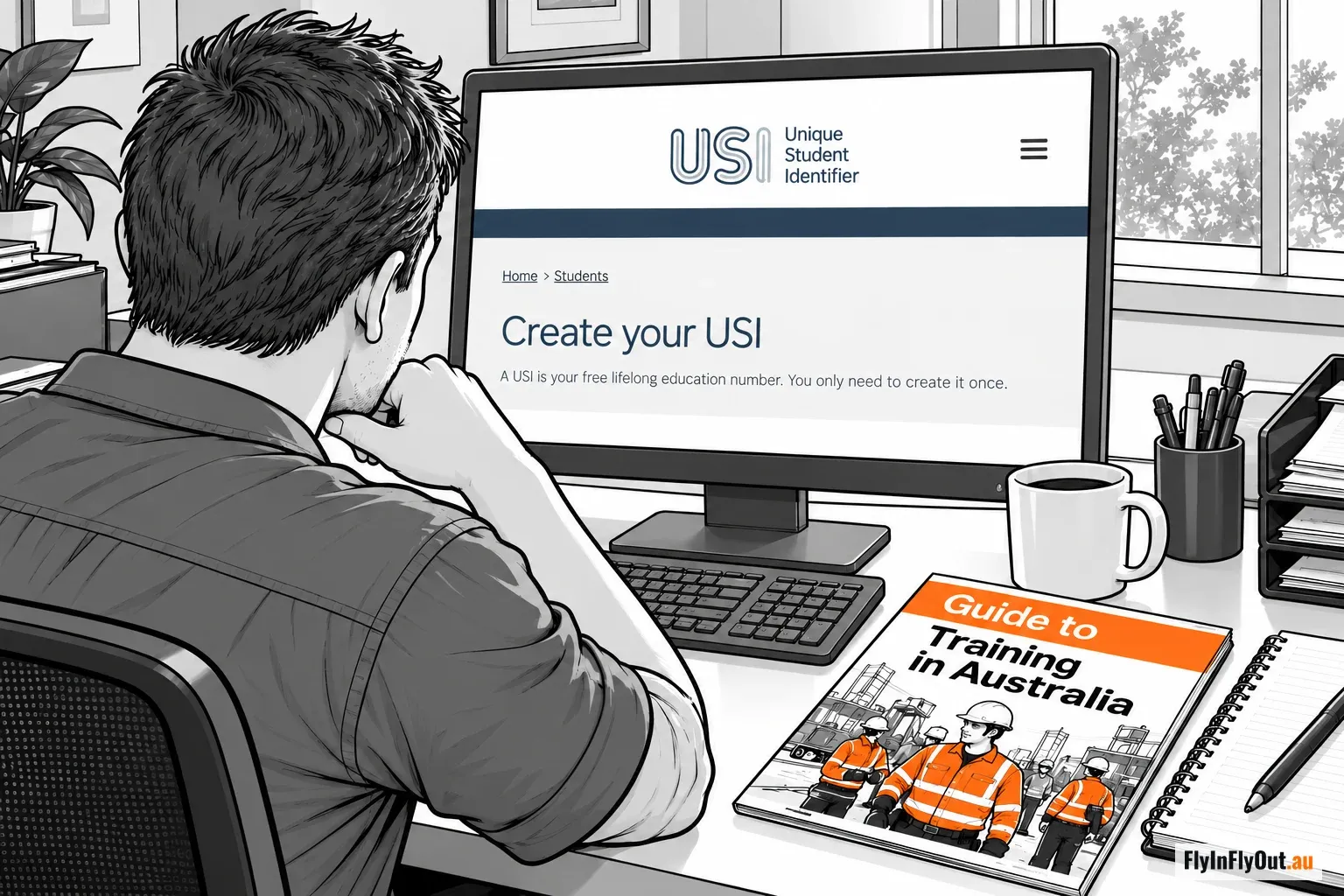
The letters USI, short for Unique Student Identifier, turn up when you book a course for your first FIFO ticket. If you've never studied in Australia, you may not have met them before. A USI is free, you only ever need one, and it's made online. Anyone who's done a ticket course before has probably got one already.
What a USI is
A USI means a Unique Student Identifier, your free education number for life, made of letters and numbers. Every nationally recognised course, from a White Card to a forklift licence, asks for it, and you may not get your certificate without one. You make it yourself on a government website, and each person only ever has one.
Your USI: Where to start
- You've done a course beforeStart here
- You've forgotten your numberStart here
- You've never had oneStart here
- You're not in Australia yetStart here
- You're not an Australian citizenStart here
- A ticket is missing from your recordStart here
Find or make your USI
Both are done on the government's USI Student Portal (opens in a new tab): choose Forgotten USI to have your number sent to you, or Create USI to make a new one.
What is a USI number?
A USI number is ten characters long, mixing letters with numbers, and it can be all letters but never all numbers. Once you have it, the same number goes on every course form you fill in, in any state.
Training providers ask for it because each course you finish is recorded against your number. For a FIFO job, that covers the tickets the ads ask for: the White Card, first aid, a forklift licence, working at heights and confined spaces.
Do you already have a USI?
Short answer
You probably have a USI if you've done a nationally recognised course in Australia since 2015, such as a ticket or a trade course. Check first, because the USI office says not to create a second one.
You can have a USI without remembering it, because a training provider can make one for a student at enrolment, with the student's permission. The Forgotten USI search will tell you.
How do you find your USI number?
Short answer
You find your USI number on Australia's USI website, usi.gov.au, by choosing Forgotten USI, then proving it's you with your email, your mobile or your personal details. The number is then sent to you.
- Go to the Student Portal (opens in a new tab), agree to the terms and choose Forgotten USI.
- Pick one way to prove it's you: your email address, your mobile number, your details with your security answers, or your details with an ID document.
- Enter the details exactly as they are on your USI account, and your number arrives.
If the portal can't find you
The search only works when your details match your USI account, so an old email address or a changed surname can stop it. Try the option that uses an ID document instead, and if nothing works, send the USI office a help request (opens in a new tab).
How do you get a USI?
Short answer
You get a USI by choosing Create USI on the USI portal and entering your details from one form of ID. It costs nothing, and the last step sets up a second check for when you log in.
Use your own email address, not a work, school or shared one. The email is one of the ways back in if you forget your number, and a work address can disappear when the job does.
The USI office suggests using the same ID for your USI, your tax file number and your myGov account (the government's online services login), so your name reads the same on all three.
What ID do you need for a USI?
Short answer
The USI office needs one ID document it can check online, such as a driver's licence from an Australian state, an Australian passport, a Medicare card or a birth certificate. If you're not Australian, a passport from home with your Australian visa counts as one.
The USI office accepts any one of these:
- an Australian driver's licence that's still current
- an Australian passport, current or expired in the last three years
- a passport from another country, with an Australian visa
- an Australian birth certificate, the full one rather than an extract
- a Medicare card
- a Centrelink concession card, if you're the main cardholder
- an Australian citizenship certificate
- an ImmiCard, the card Home Affairs issues to some visa holders and permanent residents
- an Aviation or Maritime Security Identification Card (ASIC or MSIC), the security cards for airports and ports
Type your name exactly as the ID shows it, hyphens and apostrophes included, because the check matches it letter for letter.
Can you get a USI from overseas, or without citizenship?
Short answer
You can get a USI without Australian citizenship, using your passport and Australian visa as ID. They only count once you've landed and cleared customs, so a visitor makes their USI after arriving.
Still overseas and booking ahead
You can book a course before you fly: tell the training provider you'll give them your USI when you arrive. Australians abroad can make theirs from overseas with Australian ID, and so can permanent residents whose Medicare card or Australian licence is still valid.
On a working holiday or another visa
The visa has to be current when you make your USI. Make it before you leave Australia, because it can't be made once you've gone, and a course finished without one may not get you a certificate.
Permanent residents and New Zealanders
Permanent residents in Australia can use their Medicare card, driver's licence or ImmiCard, or their passport and visa. New Zealanders use their New Zealand passport, which only works as ID after they've arrived and been through customs.
The other numbers to sort when you land, like a tax file number, are on the pages for arrivals from the UK and New Zealand.
What does your USI transcript show?
Short answer
Your USI transcript lists the nationally recognised courses you've finished since 2015, free in your USI account. You can use it to prove your tickets to an employer, or when a card goes missing.
Sharing it with an employer
You can download the whole transcript or only the courses you pick. It can also be shared as a link with a QR code, open for anywhere from a week to six months.
When a new ticket isn't on it yet
Training providers send in their records every quarter or once a year, so a course you did last month may not show yet. Keep your certificate until it does, and if a course is missing or wrong, the provider that ran it is the one who fixes it.
Ready to sort your USI?
Have your ID and a personal email handy, then head to the portal.
With your USI sorted, the next question is whether FIFO suits you. It's six questions, three minutes and free.
Is FIFO right for me?