FIFO Electrician Jobs
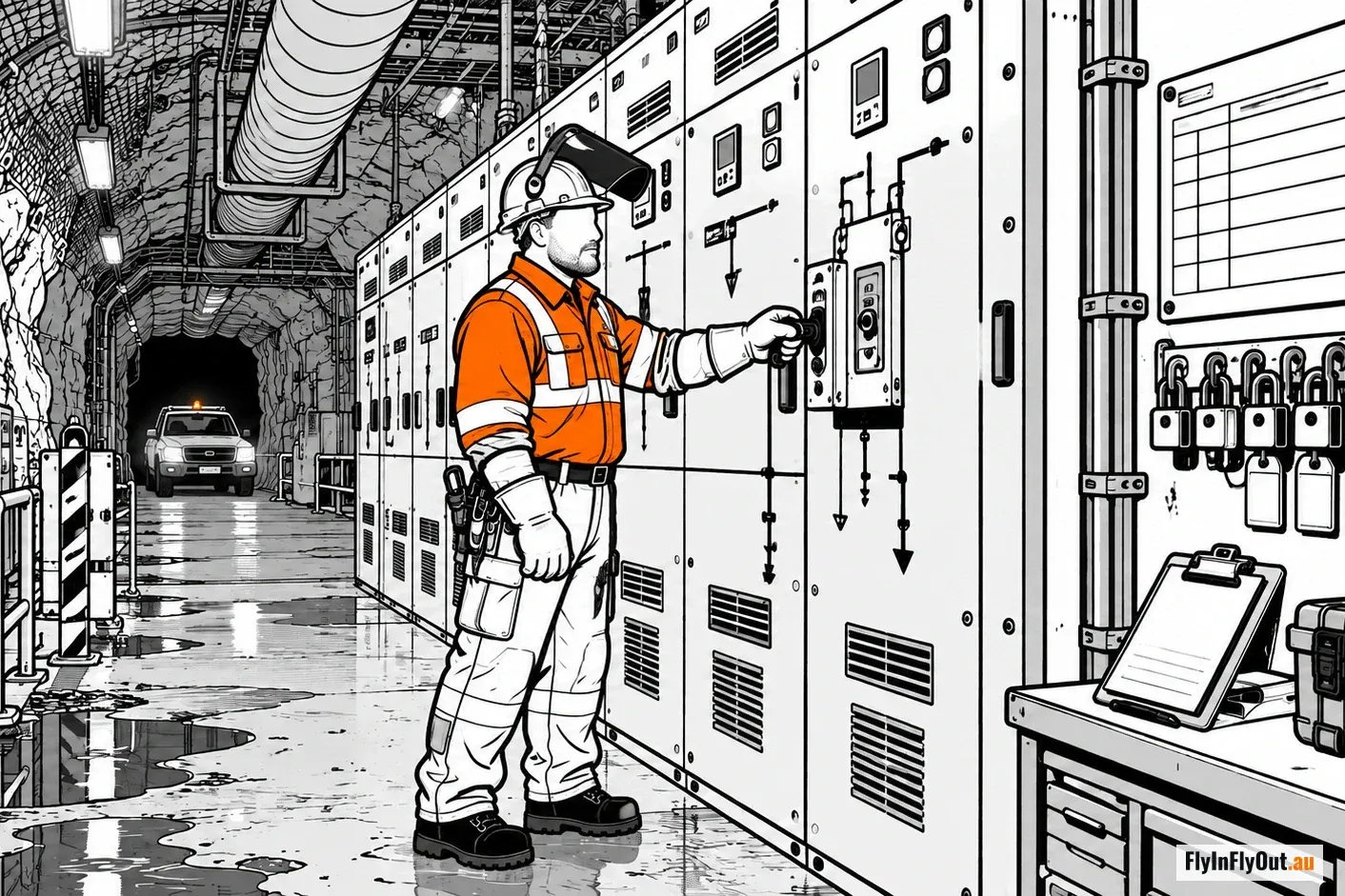
One FIFO sparky posted a video of his swing at a port in Port Hedland. He was up before three for the gym, ate ten eggs at the mess, did twelve hours on the tools and was in bed by eight, fourteen days straight, then home for a week. He wasn't complaining; he was showing the lads back home what the money costs. If that's you, the licence is what gets you hired, and the hours are the part you're deciding on.
What a FIFO electrician is
A FIFO electrician is a licensed electrician who flies to a mine, gas plant or construction site for a swing of one to three weeks and lives in camp. The work is industrial: plant maintenance, construction wiring, power distribution and camp upkeep, on twelve-hour shifts.
FIFO electrician jobs: Where to start
- Qualified, never worked on a siteStart here
- Licensed in another stateStart here
- Apprentice or provisional electricianStart here
- Auto electrician or fridgieStart here
- Want the top rates: high voltage (HV), instrumentation, hazardous areasStart here
- Trained overseasStart here
Find FIFO electrician jobs
SEEK listed 3,785 FIFO electrician jobs across Australia in October 2026. The ads are on SEEK (opens in a new tab), Indeed (opens in a new tab) and Jora (opens in a new tab). The titles vary, so search industrial electrician, construction electrician, maintenance electrician and E&I (electrical and instrumentation) technician as well.
Before you apply, check where each ad's flights leave from, called the point of hire. Getting there is usually up to you.
FIFO electrician jobs at a glance
| Pay | $60 to $105 an hour casual and contract; $120,000 to $151,950 a year salaried, plus allowances |
|---|---|
| Rosters | 2:1 (two weeks on, one off) on construction and projects; 8:6, 7:7 or 2:2 on maintenance; 14:7 on some camp jobs; twelve-hour days |
| Flies from | Perth for the WA ads, Brisbane and Townsville for Queensland, Darwin for the Territory; a few big projects fly from any capital city |
| You'll need | Your state's electrical licence, matched to the site's state (WA A-Grade in WA), LVR (low voltage rescue) and CPR (cardiopulmonary resuscitation) within a year, White Card, driver's licence, first aid |
| Experience | Industrial or mining experience on most ads; a few contractors take first-timers with a licence |
| Who hires | Electrical and maintenance contractors, labour hire agencies, camp maintenance contractors; Mineral Resources and Glencore direct |
Pay from the job ads of 12 October 2026 across Australia.
Can you get a FIFO electrician job with no site experience?
Short answer
You can get a FIFO electrician job with no site experience if you hold an unrestricted electrical licence, because some contractors advertise for licensed sparkies new to FIFO. The bulk of the ads want industrial experience, so the first job is with the contractors that don't.
The catch is that house wiring doesn't count for much on a mine site. Clipping cable in roof spaces is a different job from steel-armoured cable, tray runs, glanding and terminating into control panels, and the ads that say "industrial experience" mean exactly that. A residential background can get you treated like a fourth-year apprentice until you've proved otherwise.
FIFO electrical apprentices and provisional electricians
An apprentice can go FIFO before the licence, because a few electrical contractors advertise FIFO apprenticeships out of Perth, and one mine owner runs its own. A provisional electrician, licensed but not yet signed off to work alone, gets on site through ads marked "licensed and provisional welcome", usually on cable installation and containment with a licensed sparky beside them. The apprenticeships page covers how those are set up.
Electricians trained overseas
An overseas electrical qualification is not a licence in Australia, and no site will take you without one. The route is a skills assessment first, then a provisional licence and gap training through the state regulator, and only then the ads. Sort the licence before the visa plans get serious; the foreigners page covers the visa side.
How do you get FIFO and mining jobs in Australia as an electrician?
Short answer
You get into FIFO as an electrician through the electrical contractors and labour hire agencies that staff the projects and shutdowns, because that is where the first-timer ads are. Have the licence and tickets current before you apply, and apply to several at once. A shutdown or a short project is the usual first swing.
Some mine owners put electricians on their own payroll. Mineral Resources was advertising auto electricians, construction electricians and power station electricians in October 2026, and Glencore a salaried maintenance electrician. Those jobs want site experience and pay by the year rather than by the hour. How mining work is organised explains who hires whom.
Step by step, as a licensed electrician in WA
- Get the licence for the site's state before anything else: a WA A-Grade for a WA site. From another state, apply to WA's regulator for mutual recognition first (the licence follows the site).
- Renew LVR and CPR if they're over a year old, and have first aid, a White Card, a manual car licence and a police check ready (the full list). Every course asks for your USI (Unique Student Identifier), a free number you make online.
- Lead your resume with any industrial work you've done, because house wiring counts for less on a mine.
- Take the short jobs when they come, because the site hours from a shutdown are what the better ads ask for.
- Base yourself in Perth if you're after the WA jobs, or look for the few projects that fly you from any capital (where they fly from).
- Once you're offered the job, the employer books the medical and drug test and the site inductions.
- On your first swing, expect permits, isolations and paperwork to take as much of the day as the tools (a typical day).
- Once you have site hours, add a ticket that pays more if you want one: high voltage switching, hazardous areas for the gas plants, or instrumentation (where it leads).
In Queensland or the Territory
In Queensland or the Territory, the same steps work on that state's licence, with flights from Brisbane, Townsville or Darwin. A Queensland coal mine also wants Standard 11 and a coal board medical, which the employer pays for.
The licence follows the site, not you
Every state and territory issues its own electrical licence, and the one that counts is the state the site is in. A Queensland sparky flying Brisbane to a Bowen Basin mine works on the Queensland licence and never needs a WA one; a Territorian on a Darwin fly-out works on the NT licence. The moment the job is in WA, it's the WA licence, and the WA ads say "WA A-Grade" because the site's rules say so.
Western Australia doesn't accept an interstate licence on its own. You lodge a mutual recognition application with Building and Energy, the WA regulator, and pay its fee; the state's page says you're deemed registered once it's lodged. The ads still ask for the WA licence in hand, so lodge it before you apply, not after the offer, or the recruiter moves to the next sparky. The details are on the WA mutual recognition page (opens in a new tab) (checked October 2026).
What the ads ask for
Most ads ask for:
- An unrestricted licence in the site's state
- LVR and CPR, renewed every year
- A White Card
- A manual driver's licence
- First aid, within three years
- Working at heights and confined space, on many of them
- A national police check, which most people get from the AFP (Australian Federal Police) online in a few days
After the offer, the employer arranges:
- A pre-employment medical and a drug and alcohol screen
- Site inductions; some ads prefer a sparky already inducted for Rio Tinto or BHP sites
Nice to have, and what each one gets you:
- A high-risk licence for an EWP (elevating work platform) with a boom of eleven metres or more: lighting towers, conveyors and anything up high
- EEHA (electrical equipment in hazardous areas): gas plants and the project ads that pay at the top
- High voltage switching: substations and the better maintenance jobs
- A Certificate IV in instrumentation: the E&I jobs
The tickets page has where to do each one and what it costs.
Where FIFO electrician jobs fly from: Perth, WA, Brisbane and Queensland (QLD)
The WA ads assume you live in Perth and will get yourself to the airport; a sparky in Bunbury or Geraldton drives up the night before. The Queensland and Territory ads work the same way out of their own capitals. The big construction projects are the exception, and a few of them fly you from whichever capital city you live in and pay for it, which is how east coast electricians get a look in without moving.
How much do FIFO electricians get paid?
Short answer
FIFO electricians were advertised at $60 to $105 an hour on casual and contract rosters in October 2026. Salaried jobs were at $120,000 to $151,950 a year plus allowances. Some hourly ads add allowances on top.
| Role | Advertised pay | Source |
|---|---|---|
| Lowest hourly ad | $60 – $70 per hour + Super | SEEK, Twoticks, October 2026 |
| Highest hourly ad | $95 – $105 per hour | SEEK, Quantum Electrical and Technical Solutions, October 2026 |
| Lowest salaried ad | $120,000 – $147,000 per year | SEEK, Sodexo, October 2026 |
| Highest salaried ad | from $151,950 Gross + Allowances + Superannuation | SEEK, Compass Group, October 2026 |
The bottom and top ad of each kind, from 20 job ads of 12 October 2026; the middle hourly figure is $83.25 an hour. Only ads that stated a figure are in the table. Most don't.
To see what any of those rates comes to after tax, over a swing or a year, put it into the FIFO pay calculator.
FIFO electrician pay: flat rate, base plus penalties, or salary
Three kinds of ad share the search, and they can't be compared by the first number. A flat rate rolls the overtime, weekend and night loadings into one hourly figure, which is why it looks high next to a base rate. The base rate ad adds the same loadings afterwards. The salaried camp jobs pay less per hour than either and are the only ones with leave and sick pay.
Casual and contract ads are the majority. Work dries up between projects, and the sparkies who treat the gap as paid holiday are the ones the flat rate catches out.
What does a FIFO electrician do?
Which electrical jobs are FIFO
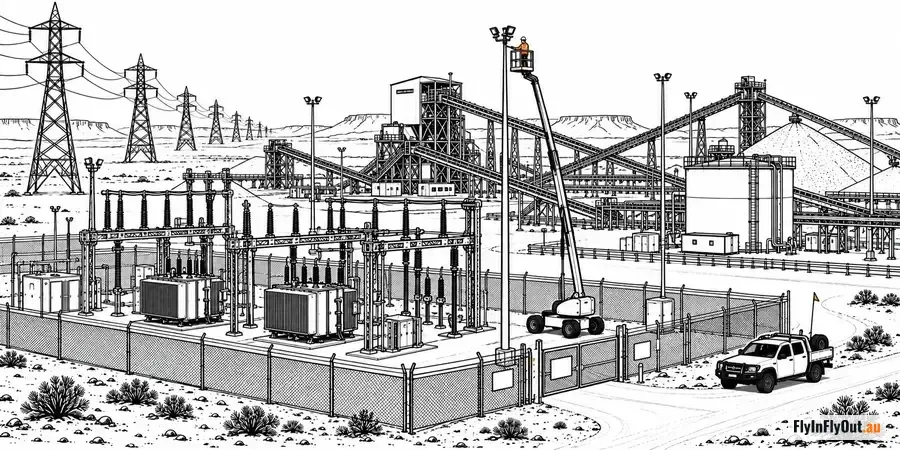
Construction electricians build the plant: cable pulls, terminations, switchrooms and hazardous area work on a project with an end date. The ads carry higher flat rates and longer rosters than maintenance. Fixed plant maintenance sparkies keep a working mine running: the processing plant, conveyors, substations, statutory testing and fault-finding, on even-time rosters. Camp maintenance is the quiet end, with dongas, air-conditioners and RCD testing on a salary and days only.
Underground electricians keep the power, communications and ventilation running below ground, on leaky feeder systems and pilot circuits most surface sparkies have never seen, and the ads ask for underground hours or a contractor willing to train them. E&I technicians (electrical and instrumentation) look after the control side: the controllers, sensors and networks that run the plant.
Auto electricians, fridgies and FIFO air-conditioning (HVAC) jobs
Searching for FIFO electrician jobs also turns up two trades that aren't electricians. Auto electricians work on the haul trucks, excavators and light vehicles, often with the diesel fitters, and the fleet contractors and some mine owners advertise for them separately. Refrigeration mechanics keep the camp's air-conditioning and the mess cold rooms going, and the camp contractors advertise those on the same salaried terms as their electricians.
A typical day for a FIFO electrician
The camp is the village of dongas, mess and gym beside the site, and the day starts there with the bus at five. On site it's locks on and permits signed, a ten-minute pre-start split by trade, a hazard check on paper, and then the isolation. The work is statutory testing, fault-finding, cable pulls and substation jobs through to the afternoon, with half an hour at ten and again at two.
The part that isn't in the ad is how slow it is. Nothing gets touched until the permit says so, the paperwork takes as long as the job, and a domestic sparky's instinct to just get it done is the thing the site is training out of you. At the end it's handover, locks off, the bus, dinner in the dust you came back in, and a shower before bed. The rosters page compares 2:1 (two weeks on and one off), 8:6 and 7:7.
What is it really like being a FIFO electrician?
Short answer
Being a FIFO electrician means twelve-hour days for the whole swing, in heat and dust, a long way from home. A 2:1 roster works 2,920 hours a year against 1,976 for a city week, and the pay has to be read against that. Most who leave say the hours did it, not the work.
The hours are the price
A city sparky on a Perth construction site sleeps at home and works a 38-hour week with penalties. The FIFO flat rate has to beat that per hour, after tax, to be worth the donga, and some ads don't. One electrician wrote online that a construction roster of nineteen days on and nine off felt like existing rather than living. He went back to a local job on less money and said he was ten times happier.
For the ones who stay, the other side is six days at home every fortnight on an 8:6, no rent and no food bill on site, and a mortgage going backwards faster than any city job can manage. If a swing turns bad, Lifeline 13 11 14 is open all hours.
Where does a FIFO electrician job lead?
Short answer
A FIFO electrician job leads to the tickets that pay more, then to supervision. The ads for each ask for the ticket and site hours behind it, so the first year on site is what opens them.
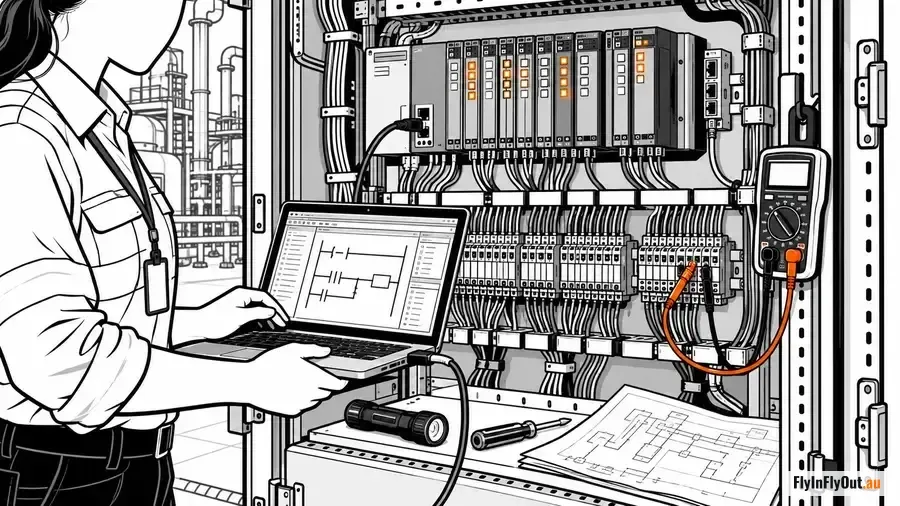
A general sparky competes with every other sparky on the board. An HV switching ticket is a short course and takes you out of that pool; an instrumentation certificate takes a year part-time and puts you in a much smaller one. The supervisors and electrical superintendents on site came up that way, and the contractors fill those jobs from the crews they already have.
Whatever the ticket, the sparkies who leave well are the ones who set a number and a year before the first swing. The FIFO Game Plan is how to set them.
Is a FIFO electrician job right for you?
Two honest questions
The question isn't whether you're a good sparky; the licence has answered that.
- Can you do the tenth 84-hour week the way you did the first? The first one is easy. The hard one comes after the kids' birthday you missed, with the project running late.
- Can you work slowly? On site the sparky who isolates, tests and tags every time is the one who gets asked back. The one who's quick is the one who gets walked off.
Ready to look?
If you've read this far and still want in, the jobs are here. Have the paperwork sorted, and send it to more than one contractor.
- FIFO electrician jobs on SEEK (opens in a new tab)
- FIFO electrician jobs on Indeed (opens in a new tab)
- FIFO electrician jobs on Jora (opens in a new tab)
- All job boards, contractors and agencies in one list
Fake ads turn up on real job boards too. An ad that asks you to pay a fee before you start is a warning sign: report it to Scamwatch (opens in a new tab).
The job is one question. Whether the life suits you is six more. Three minutes. Free.
Is FIFO right for me?