How to Get Into FIFO

Getting into FIFO is harder than the job ads make it look and easier than most people make it. Without a trade there are a few realistic doors, and none of them is the one everyone queues at. With a trade you're closer than you think, but "city-qualified" and "FIFO-ready" are different things.
How to get into FIFO: Where to start
- A qualified tradie in a capital cityStart here
- No trade, fit, and want the money fastStart here
- No trade, and you'd rather not break your backStart here
- A woman weighing it upStart here
- On a working holiday visaStart here
- Over fiftyStart here
How hard is it to get into FIFO?
Short answer
FIFO is hard to get into in one specific way: almost everyone applies to the same few hundred online ads, so almost everyone is competing with everyone else. The people who get in quickly are the ones who apply somewhere the queue isn't.
The ads make FIFO look simple, even for people who should have it easy. I read about a plumber from Sydney, qualified and licensed, with years of experience, who looked at the FIFO ads and thought: they need plumbers, this should be straightforward. It wasn't.
He wrote that he applied for months and heard nothing, not because he was a bad plumber but because he was a city plumber. He'd never worked remote, never done fourteen-hour days in heat that makes tools too hot to hold, and never lived in a camp or been three hours from a hospital. His résumé said "experienced tradesperson", and the hiring managers read "someone we'd have to babysit".
How one plumber got in
The Sydney plumber moved, and not to Perth. He spent the better part of a year plumbing in remote Aboriginal communities in Western Australia, at local rates, in forty-degree heat. He did it so his résumé could say he'd worked remote, in extreme heat, for long hours, and hadn't folded.
After that the doors opened, and he got his start in the Pilbara. It took him five years from first application to first swing, and every one of those years was the cost of not knowing the path.
How do you get started in FIFO?
Short answer
You get started in FIFO through one of three doors: a trade, a relevant degree, or a bottom-rung job such as camp services. A trade gets you the most direct route and a degree a graduate program; without either, camp services has the shortest queue.
With a trade
Fitters, electricians, boilermakers, auto electricians, plumbers and diesel mechanics are wanted constantly, and heavy diesel fitters in particular are in permanent demand. If you don't have a trade and you're young enough to consider an apprenticeship, have that conversation with yourself seriously. The financial hit is real and the long-term return is a job that will always exist in this industry.
With a degree
Mining engineering, geology, surveying and environmental science all have graduate programs. They're competitive, but the pathway is structured and the entry point is defined.
With neither: entry-level fly in fly out jobs
Your path starts at the bottom, and in FIFO the bottom is not a desk. It's trade assistant, driller's offsider, or camp services: cooking, cleaning, washing dishes, mass food preparation, for the companies that run the accommodation.
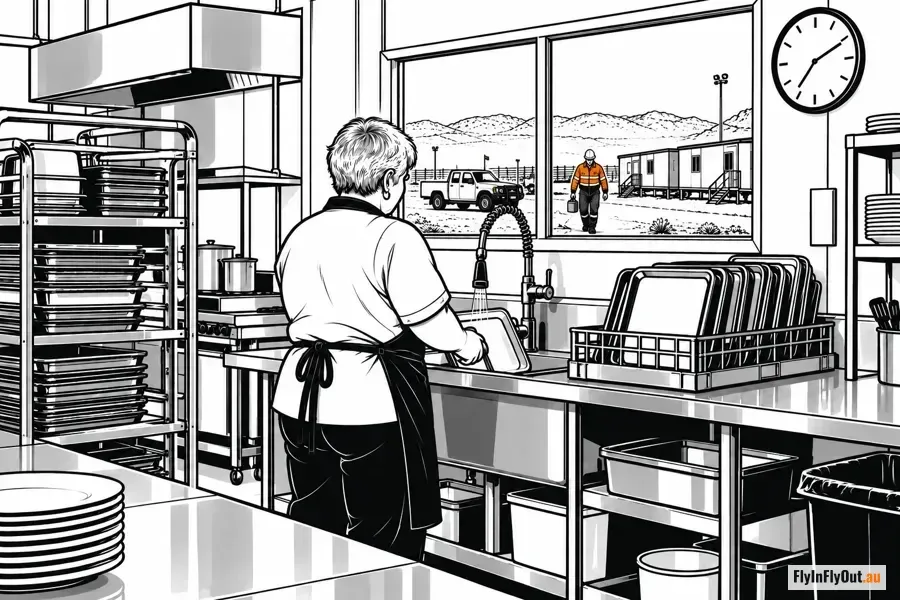
Here's the thing. Everyone applies to BHP and Rio Tinto, because that's the name on the ad. Almost nobody applies to the catering contractor that runs the camp, and they hire constantly, because the work is unglamorous and the turnover is high.
Six months washing dishes for one of them gets you three things: mine site experience, a site induction on your record, and people who've seen you work. From there you're not applying from the city. You're applying from site, and the person reading your résumé knows you've already survived the thing most applicants haven't.
Driller's offsider, the other door
Driller's offsider is the other door for someone without a trade, and it is brutal. It means long hours of hard physical labour with heavy drill rods, sample bags and rig maintenance, in conditions that test everything you think you know about your own endurance. If you can last a year, it proves the one thing no ticket can: that you'll last.
FIFO jobs with no experience has the four jobs that take first-timers, what each one pays and how to get it.
What do you need to qualify for FIFO?
Short answer
To qualify for a FIFO job you need a manual driver's licence, a White Card, a national police clearance, and to pass a medical with a drug and alcohol screen. Everything else depends on the role, such as first aid, Working at Heights, Confined Space or a Heavy Rigid licence. Buying all of it before you have a target role is spending money to feel prepared.
The FIFO requirements every site asks for
A White Card is the general construction induction, cheap and quick, and no site admits you without it. The police clearance is standard; most employers organise it at onboarding, but holding a current one saves time.
A pre-employment medical is thorough: fitness, hearing, vision, lung function, joints and back. It's not a quick check-up. It's designed to confirm you can do demanding physical work far from a hospital.
It includes drug and alcohol screening, usually urine and sometimes hair, and the policy on most sites is zero tolerance. The test comes before your first swing and at random after it. Know where you stand before you spend money on anything else.
Tickets that depend on the role
The role tickets are valuable and some roles require them, but not every entry role needs all of them. Get the ones your target role asks for. What each one costs, and where to do it, is on FIFO tickets.
What not to pay for
Training companies sell "FIFO-ready certificates" and "mining preparation courses" for $1,500 to $3,000. Some are fine. Some are bundling tickets you could get for half the price and calling it a program.
No hiring manager asks for a FIFO-ready certificate. They ask for a White Card, an HR (heavy rigid) licence, Working at Heights, and evidence you can do the work. Buy the tickets and skip the certificate.
The FIFO résumé page shows how to list your tickets so a recruiter sees them first.
You're not too old at 40 or 50, either. A FIFO job-help business on YouTube says one of its clients landed her first FIFO job in her late fifties, and that passing the medical mattered more than her age. What changes with age is the job to aim for: machines, a trade, the store or the bus ask less of a body than labouring all shift.
How do people actually get hired for FIFO?
Short answer
People get hired for FIFO by being seen: phoning or walking into the company or agency with the basic tickets in hand. Once on site, the next job comes from being the worker a crew will vouch for. FIFO runs on reputation.
The nod at the door
It's Saturday night, and the queue outside the club stretches past the kebab shop. Everyone in it is dressed up and waiting. Halfway down stands Sam, with the same jeans, the same shoes and the same patience as everyone else.
Then the bouncer looks up from his clipboard, spots Sam and gives a small nod: "You, come on." Sam walks past everyone in front and straight through the door.
Is it fair?
Is it fair? It's not, really, and it probably isn't by the book either. But the bouncer isn't thinking about fairness. He's thinking about his night.
He knows Sam, because Sam has been in before. Sam knows how the place works, doesn't start fights, doesn't need babysitting and won't be thrown out by midnight. Everyone else in that queue is a maybe. Sam is a known quantity.
That's the whole game.
Swap the club for a mine site
Say two plumbers apply for the same FIFO job. Mark has worked in the city for fifteen years, has the licences and tickets you'd ask for, and has good references. Ask him to fix anything and he'll fix it.
Jase has the same trade and fewer years in it, but two of those years were on a site up north.
The recruiter has a pile of applications on her desk and a client who's tired of hiring people who quit after their first swing. She reads both résumés, and Jase gets the call.
Why Jase gets the call
Jase isn't chosen because he's the better plumber, and Mark might well be. He gets it because he's already been inside the club. He's done the four o'clock starts and the forty-degree days, and he's lived in a donga, the small prefab room everyone on site sleeps in.
He knows what two weeks away from family feels like, not what he thinks it might feel like. He knows the safety rules aren't suggestions, and he's shown he comes back for a second swing. Mark is a maybe. Jase is the known quantity.
Why fly in fly out employers want someone who's done it before
FIFO has high turnover. People sign up for the big money, do one or two swings, find the life harder than they thought and leave. Each time that happens, the company loses what it spent on flights, inductions and training, and it has to hire all over again.
So the people choosing who gets in aren't really asking, "Can this person do the job?" Plenty of people can do the job. They're asking, "Will this person stay and do the job?"
Moving first costs a year in a hot town on local rates. What it buys is a résumé that says "remote" before anyone has to take your word for it.
How to apply for FIFO jobs: ring the company
To apply for FIFO jobs in Australia, don't stop at clicking apply: ring the company too. One bloke wrote online about getting in as a driller's offsider with no trade and no experience, and he did two things worth copying. First, he spent his own money on a Heavy Rigid truck licence before applying. The offsider job didn't need it, but it made him employable for more roles, and it showed a hiring manager one person, among all the applicants with no experience, who had invested in himself first.
Second, when he found a company hiring on a job board, he didn't click apply. He went to the company's website, found the number, and rang. He got the interview and the job, and the HR manager booked his medical on the spot. It shows where the bottleneck often is: not the company's willingness to hire, but the supply of people who've shown they'll do the work.
When your crew vouches for you
Once you're in, reputation keeps working for you. One scaffolder wrote online that he started with basic tickets and no trade, and spent his first two years learning, surviving and trying not to be the one who slowed the crew down.
He turned up, did the grunt work, didn't cut corners, and didn't complain more than was reasonable, which on site means you can say it's hard but you can't make it everyone else's problem. When better jobs came up on other sites, his crew vouched for him without being asked. Eight years in, he was working offshore in oil and gas. That's work you don't apply for: you get invited, because someone who has worked beside you picks up the phone and says "this bloke's solid, get him in".
How long does it take to get into FIFO?
Short answer
The time from deciding on FIFO to your first swing is weeks to a few months if you have the basic tickets and will go where the work is. Without that, it can be years. A tradesperson coming from the east coast should allow longer than a local, because proving you can handle remote work takes time on its own.
Getting in is a project, not a lottery. The people who treat it as a project, who buy the right tickets and not the others, and prove they can handle the conditions, get in. It takes longer than the ads imply, and it starts where everything in FIFO starts: with a plan, before the first application, the first ticket, or the first phone call.
Are you ready to get into FIFO?
Four honest questions
- Can you do fourteen days straight before a day off? The question isn't whether you think you could. Have you done anything close?
- Who handles your life while you're gone? Rent, bills, pets and relationships all keep going while you're away. The logistics of absence are part of the plan, not an afterthought.
- Have you done the hourly maths on the ad you're looking at? Divide the salary by the hours on site for that roster. The headline number is not the number that matters.
- Can you fund the tickets, the medical and a month of waiting? There will be a gap between being ready and starting work. Budget for the gap.
Those four questions aren't a quiz. This is: six questions that weigh what actually decides whether FIFO works. Three minutes. Free.
Is FIFO right for me?