FIFO Jobs in Australia From the UK
To understand the likelihood of you being hired for a mining job in Australia from the UK, walk a mile in the boots of the person hiring.
One application is from you, in the UK, with no mining experience, and hiring you means waiting while you cross the world, then betting you can handle the heat, the flies and the long shifts.
Meanwhile, they have a pile of applications from locals with the same lack of experience, who are already in Australia, don't need a visa and won't quit to fly home.
Who would you pick?
That's the answer: you don't get a FIFO job from the UK; you get to Australia first.
What FIFO from the UK means
FIFO from the UK means a British or Irish worker doing fly in fly out mining work in Australia, not commuting from Britain. The job starts and ends at an Australian airport, so you move first, on a visa that lets you work, and get hired there.
FIFO from the UK: Where to start
- No trade, under 35Start here
- Sparky, fitter, boilermaker or welderStart here
- Over 35, or want to stay for goodStart here
- HGV licenceStart here
- From IrelandStart here
- Already in AustraliaStart here
FIFO from the UK: Is it possible?
It is possible once you're living in Australia with the right to work, and it isn't from the UK. The usual way is the 417 visa, a one-way flight to Australia and the safety courses. Then you apply for the first-timer ads on SEEK (opens in a new tab), Indeed (opens in a new tab) and Jora (opens in a new tab) from an Australian address. The visa rules are on the Home Affairs page (opens in a new tab).
Before you apply, check where each ad's flights leave from, called the point of hire. Getting there is usually up to you.
FIFO from the UK at a glance
| Possible? | Yes, from inside Australia on the right visa; no, from the UK |
|---|---|
| Which jobs | Camp utility, trade assistant and shutdown crews on the holiday visa, where the ad allows it; your trade once it's recognised |
| Who is open to it | Camp contractors, labour hire agencies and shutdown contractors; the mine owners rarely, and almost never from overseas |
| The catch | Many entry-level ads want citizens or permanent residents, the six-month rule can limit time with one employer, and UK electrical qualifications aren't an Australian licence |
| Flies from | Perth for WA sites, Brisbane for Queensland, Darwin for the Territory and Adelaide for South Australia |
Visa and listing facts checked October 2026.
Can you do FIFO in Australia from the UK?
Short answer
You can do FIFO in Australia from the UK once you are living there with a visa that allows work, and almost never before. Australian employers and agencies rarely hire for entry-level jobs from overseas, because the local queue is long. The way in is the working holiday visa, then an address in a FIFO hub such as Perth or Brisbane, then applying for jobs like a local.
The catch is that UK work outside mining counts for little on an Australian mine. A recruiter for a Pilbara mining company put it plainly when a Brit asked about FIFO online: "Your non-mining skills have no value whatsoever in this industry." The recruiter's advice was to expect labouring or trade assistant work at first, and that work is how you build the experience that counts, which is time on an Australian site.
The working holiday visa: the British path
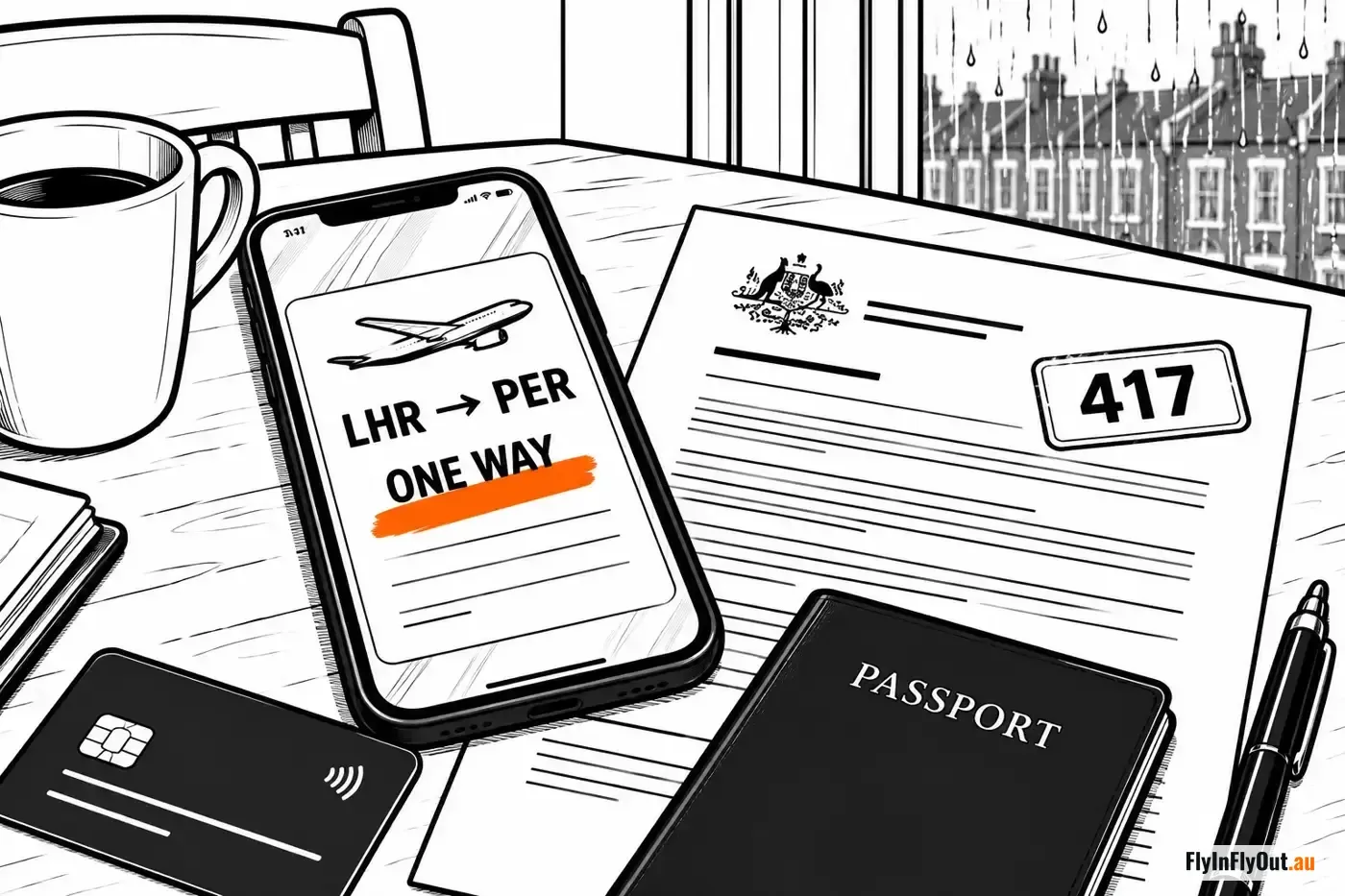
The 417 working holiday visa is open to UK passport holders up to the age of 35, and it's the usual way in for a young Brit. Apply well ahead, because Home Affairs expects it to take about three months and asks you not to book flights until it's granted. Land in Australia, do the tickets, and take a camp or trade assistant job in the first year.
Since July 2024, a UK passport holder can apply for a second and a third year without the regional work most other passports need, as long as they're still 35 or under. Read each ad's visa line before you apply, because many entry-level driller's offsider ads on SEEK in October 2026 wanted Australian citizenship or permanent residency, and so did some camp utility ads.
The working holiday visa: the Irish path
An Irish passport gets the same 417 visa to the same age, with one extra step. The second year has to be earned with three months of regional work in the first, and the third year with six months in the second. Mining in a regional postcode is on Home Affairs' list of work that counts, so a FIFO job can be the regional work rather than a job you do before it, as long as the site and the job qualify. The list counts mining support services, cleaning included, and hospitality in remote and northern areas, so a camp job can count too, but check your own site's postcode before you rely on it.
Six months with one employer
Working holiday makers can usually work only six months for any one employer, and the clock runs in calendar months from your first day, not in days on site. With a labour hire agency, Home Affairs counts the business the agency sends you to as the employer, so each new business starts a fresh six months, and switching agencies doesn't restart one. A second visa starts the clock again, even with an employer from your first year.
Since January 2024 the limit hasn't applied to mining and construction in Northern Australia, a postcode list that takes in Pilbara towns such as Newman, Tom Price and Port Hedland, and Queensland coal towns such as Moranbah and Dysart. Hospitality work anywhere, including catering and housekeeping, is exempt too, and so is the same employer at a different site, as long as no one site runs past six months. The exemptions last until the Government decides otherwise, so check your own job on Home Affairs' six-month page (opens in a new tab) before you plan around them.
Over 35, or wanting to stay
Without the 417 there is no first-timer door from the UK. The sponsored visas, the Skills in Demand visa and the points-tested permanent ones, go to trades and professions on the skills lists with work experience after qualifying: diesel fitters, boilermakers, electricians, engineers, geologists. A labourer, a truck driver or a camp utility is rarely sponsored, because the queue in Australia is full of locals. The foreigners page has the visa table.
How do you get a FIFO job from the UK with no experience?
Short answer
You get a FIFO job from the UK with no experience by not applying from the UK. Land in Australia, get a local phone number, bank account, tax file number and address, do the tickets, then apply to the contractors and agencies.
The order matters more than the effort. Applications from a UK phone number and address usually go nowhere, because the medical and the inductions happen in the city you'll fly from, often at a few days' notice. So the first fortnight is the setup.
Two numbers can't be sorted from the UK, because their online applications only open once you've landed. In your first days in Australia, apply for a USI, the Unique Student Identifier that training providers ask for, and for a tax file number, which comes by post within 28 days.
One reply on a Perth forum summed up the basics in six words: "Right to work, drivers licence, heartbeat." Add a White Card and a police clearance, and for the drilling and truck ads a Heavy Rigid licence, and you're as ready as the Australian beside you, apart from the visa.
Step by step, from the UK
- If you're 35 or under, apply for the 417 working holiday visa, and wait for the grant before you buy a flight (the British path; the Irish path).
- With an electrical licence to transfer, start the skills assessment before you leave, because it can take well over a year (with a trade).
- Land in Perth or Brisbane, set up an address, phone and bank account, and get your USI and tax file number moving straight away.
- Get your White Card and police check done, and an HR (heavy rigid) truck licence if you want the drilling or truck jobs; your UK car licence is fine on the 417 (what else to get). Every course asks for your USI (Unique Student Identifier), a free number you can make only once you've landed.
- Check the visa line in every ad, and plan around the six-month limit with one employer, which doesn't apply to mining in Northern Australia (six months with one employer).
- Apply to the agencies, the camp companies and the shutdown crews from your Australian address (how agencies work).
- Never pay an agency or anyone else to put you forward for a job (the fee rule).
- Once you're offered the job, expect the medical and inductions in your hub city at short notice, then a first swing that starts at four in the heat (what it's really like).
Who pays the flights
The flight from the UK to Australia is yours to pay, and so is everything before the first swing, from the tickets to the first weeks of rent. Once you're hired, the employer pays the flights between the point of hire, usually Perth or Brisbane, and the site.
If you've got a trade
A UK electrical qualification isn't an Australian licence, and you can't work as a sparky in Australia until the state licenses you. On the Down Under Centre podcast, a UK electrician described the route: a skills assessment, a technical interview and a practical, then a provisional licence, gap training and the full licence. The whole thing took him about a year and a half, working a 3:1 roster (three weeks at work, then a week off) at the same time.
His advice is to start early, and he did his practical on a trip home for a mate's wedding, saying it got processed quicker there. Until the licence comes through you work as a trade assistant, and the ads will pay you as one. The electrician page explains which state's licence you need.
Boilermakers and welders don't need a licence to work in WA, according to the state's Build a Life careers site (opens in a new tab), so whether your UK papers count is up to the employer. A young Brit said in a video that he started FIFO as a boilermaker on the welding tickets he'd earned in the UK. For a skilled visa later, fitters, boilermakers and welders get their trade assessed through Trades Recognition Australia.
If you've got an HGV licence
A UK HGV licence has to be tested again in Australia, though a UK car licence doesn't: the car licence is on the recognised lists in both WA and Queensland, so it transfers to a local licence without a test. While you're on the 417 you don't have to transfer it at all, provided the UK licence is current.
WA's Department of Transport and Major Infrastructure (opens in a new tab) makes you sit a heavy vehicle theory test and a driving assessment in the class you want, though your HGV years may count towards the experience it asks for. Queensland makes you pass a road rules test and a practical driving test for any heavy class, under its overseas licence rules (opens in a new tab). Heavy Rigid is the class the offsider and service truck ads prefer.
What is FIFO really like for someone from the UK?
Short answer
FIFO for a Brit is the same twelve-hour days and heat as for anyone, plus a visa clock and a long way home. The working holiday visa's time limits make you a short-term hire, and a trip home takes a whole swing off and a long-haul fare. Some Brits say it's worth it; others say the money didn't make up for the time away.
The heat test
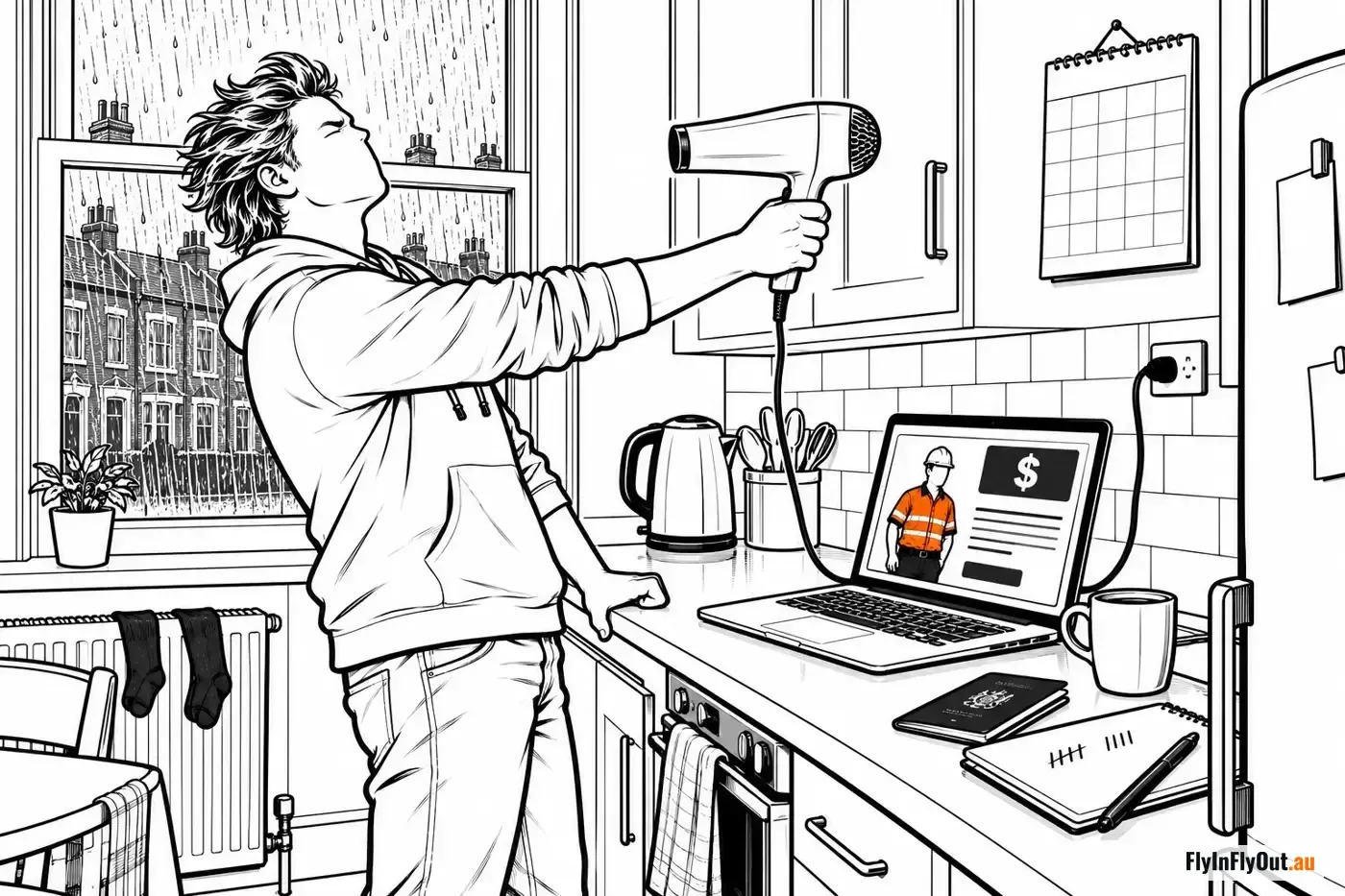
A man from Leeds who'd worked in the Pilbara posted a test for the heat: "point a hairdryer at your face from about three foot away and see how long you can stand it." His day was up at four, a bus to site, back to camp by seven, then a shower, dinner, a call home and bed, sometimes for thirteen or twenty days straight. He wrote that the days off go on "trying not to sleep constantly", and that underground is hotter than outside, and more humid.
Camps cap the drinking too. The Leeds man wrote that most camps allow four beers a day, and that going over would put you on the next plane home. A UK sparky on a migration podcast said every prestart, the meeting at the start of each shift, includes a breath test, and anything above zero gets you sent off site.
Then there's the one part that's about being English. One forum reply warned that some blokes on site hate everything and everyone, the English especially, and another said the regulars "may not warm up to you straight away". The man from Leeds asked himself whether it's worth it and answered "absolutely", with one warning: "Just don't spunk all your cash on fishing boats, motorbikes and jet skis."
The trip home

An Englishman who wanted to try FIFO planned to fly home every three to six months. A 2:1 roster (two weeks on, one off) leaves a week between swings, and London is about a day's travel each way, so one reply called that pretty much impossible and suggested Bali instead. Plan on one trip home a year, and budget the fare yourself. If a swing turns bad, Lifeline 13 11 14 is open all hours.
Where does a FIFO career from the UK lead?
Short answer
A FIFO career from the UK can lead a tradesperson to a skilled visa and permanent residency, and everyone else to a few years of work and savings. A UK trade recognised in Australia is the usual route to staying; an entry-level job on a holiday visa isn't, on its own.
A UK electrician on a migration agency's podcast is the version that goes all the way. He landed in Perth on the 417, had his first FIFO job, on a solar farm, within three weeks, and became a fully licensed sparky along the way. He had permanent residency two and a half years after landing, and put it down to starting early, with the paperwork moving before he'd even flown out.
The other version is a man who wrote that he "did it all through my 20s and I wouldn't go back now, I make half as much but the lifestyle improvement is invaluable." Both are the same decision made on the first day: what the money is for, and when it ends.
Is FIFO from the UK right for you?
Two honest questions
- Can you fund the flight, the tickets, the rent and two months with no pay? The first swing can be weeks away from the day you land, and the rent doesn't wait.
- Are you going for a year, or for good? The visa decides which jobs will take you, and a trade decides whether staying is possible at all. Know the answer before you book the flight.
Ready to look?
Read the ads from the UK for the shape of the work, and apply once you're in Australia with the setup done.
- Entry-level FIFO jobs on SEEK (opens in a new tab)
- Entry-level FIFO jobs on Indeed (opens in a new tab)
- Entry-level FIFO jobs on Jora (opens in a new tab)
- All job boards, contractors and agencies in one list
Fake ads turn up on real job boards too. An ad that asks you to pay a fee before you start is a warning sign: report it to Scamwatch (opens in a new tab).
The move is one question. Whether the life suits you is six more. Three minutes. Free.
Is FIFO right for me?