Mining Boots
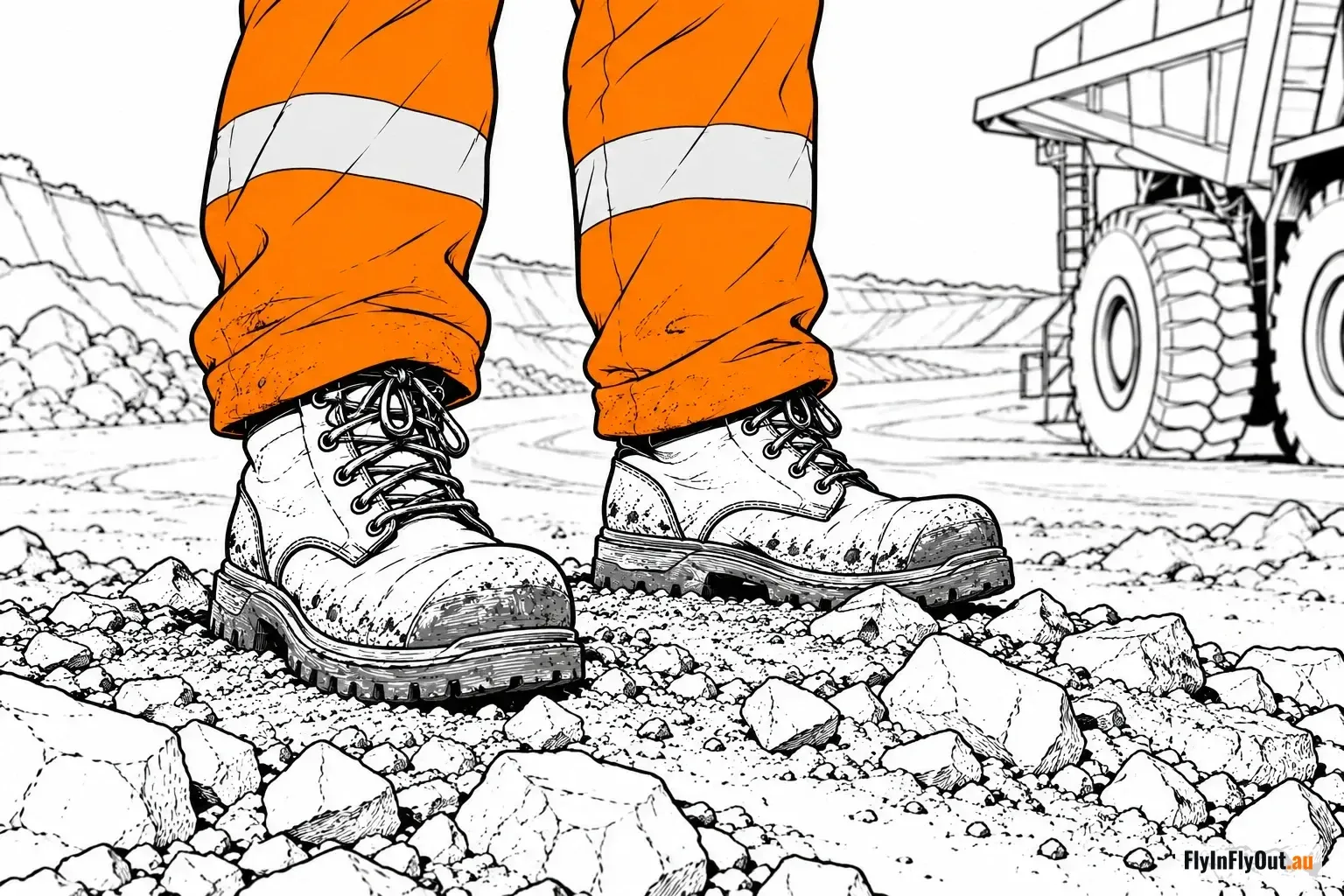
A new pair of mining boots can cost you twice: once at the shop, and again if the site says they're the wrong kind. The site sets the rules, and under WA law the business you work for has to supply the boots, so find out both before you spend a cent. Then pick for your feet and your flights, and break them in before day one.
What mining boots are
Mining boots are safety boots built for mine sites, with a protective toe cap and a collar that comes up over the ankle. On site, people often just call them steel caps, even when the cap is composite.
Quick checklist before you buy
Will the company supply them?
Under WA law, whoever directs your work has to provide safety boots at no cost, and some employers pay an allowance instead. With labour hire, ask your recruiter who hands them out; for Queensland, ask the employer. If they're supplied, you don't need to buy a pair. Read more
What does your site's gear list say?
A site's gear list asks for boots made to AS 2210.3, the Australian standard, plus rules of its own, like lace-ups with ankle support. Get the list from your recruiter before you spend. Read more
Does your job or state have its own rule?
In WA, electricians need non-conductive boots, and composite caps stay non-conductive even when damaged. Electricians in other states should check with that state's electrical regulator. Fortescue's rail crews have to wear steel caps. Read more
Steel caps or composite?
Steel and composite caps pass the same safety standard. Composite is lighter, and metal-free boots are easier at airport screening if you fly in them. Read more
Laces, a zip or pull-ons?
Lace-ups are the safer buy, because Mineral Resources and Fortescue both ask for laces and won't take pull-ons. A side zip means you tie them once, then zip them on and off. Read more
Do they fit?
Try them on with thick work socks, in women's sizes if you need them, and make sure they're wide enough, not just long enough. Then walk them in at home before day one. Read more
If you're buying your own, the boot that ticks the most boxes is a side-zip lace-up with a metal-free composite cap, unless your job needs steel caps.
Checked October 2026.
Where to get mining boots
Workwear stores sell mining boots in person and online, from brands like Steel Blue, Oliver, Blundstone, Mongrel and FXD. In October 2026, Workwearhub listed lace-up and zip-sided pairs from about $200 to $280, and most were on sale for less.
What safety boots do you need for a mine site?
Short answer
Mine sites need safety boots made to the Australian standard for safety footwear, AS 2210.3. Each site adds its own rules on top, such as laces and ankle support. Your site's induction pack, or the safety gear list your recruiter sends, has the final word.
Older documents call the standard AS/NZS 2210.3. Since 2019 it has been an Australian-only standard, and it tests the toe cap against a heavy impact and a crushing load.
The site rules go further because the ground is rough and heavy machines work close by. Laces hold the boot firm on broken ground, and a tongue sewn in at the sides keeps grit and mud out.
Ask for that list before you spend anything, because a boot that passes at one mine can fail at the next.
Do you have to buy your own mining boots?
Short answer
WA's work health and safety laws make the business directing your work supply your safety boots, and it can't charge you for them. Some employers pay a safety gear allowance instead.
The law calls this safety gear PPE, short for personal protective equipment, and boots are on the list. The ads say it too. In October 2026, Sodexo's FIFO utility ad on SEEK said PPE was provided, and ISS's FIFO bus driver ad from September 2026 included steel cap boots.
Labour hire is where it gets murky. The labour hire company and the site share the duty to provide safety gear, so ask your recruiter which one hands out boots before you buy a pair.
Queensland's mines run under separate mining safety laws, so if you're headed there, ask the employer what they supply.
If you pay for them yourself
If you buy your own and nobody pays you back, the tax office lists steel-capped boots as protective footwear you can claim. Keep the receipt.
Should your mining boots have steel caps or composite?
Short answer
Steel cap safety boots and composite ones meet the same Australian standard, so both protect your toes. Composite caps are lighter and don't conduct electricity. Metal-free composite boots won't set off an airport metal detector either.
Steel Blue, Oliver and Blundstone each sell metal-free composite versions of their mining boots. Mongrel makes steel caps only.
Flying in them
Perth Airport asks you to take steel-capped boots off at screening and put them in the tray. Body scanners pick up more than metal, though, so you can still be asked to take a metal-free pair off.
Look for "metal free" on the label, not just "composite toe". The cap can be composite while the lace rings, eyelets or sole still carry metal.
Wearing your boots on the charter keeps their weight out of your bag, and charter weight limits are tight.
Electricians and rail crews
Electricians have a rule of their own. WA's electrical safety regulator, Building and Energy, says electricians' safety footwear must be non-conductive, and a composite cap stays non-conductive even if damage exposes it. Other states have their own electrical safety regulators, so check with the one where you'll work.
Fortescue's contractor rules accept composite caps on its iron ore sites, but its rail work needs steel caps.
Can you wear pull-on boots on a mine site?
Short answer
Pull-on safety boots, the elastic-sided kind, aren't allowed where a site's rules say lace-up. Fortescue's and Mineral Resources' contractor rules both say lace-up, so check your site's list first.
Laces let you set the fit around your ankle, so the boot stays put on loose rock and in mud. Elastic sides stretch with wear, and a boot that slips at the heel is where blisters start.
Adding a side zip gives you both. You set the laces once, then zip in and out at the camp door and at airport screening.
What pull-ons save you
Pull-ons do cost less. Workwearhub's full prices in October 2026 put Steel Blue's and Oliver's pull-ons about $50 to $70 under the same brands' lace-ups. The saving is gone if the site sends you to buy another pair.
Blundstone's elastic-sided boots are the classic slip-on, and the brand also makes zip-sided lace-up safety boots, like its 992.
How do you stop mining boots hurting on a 12-hour shift?
Short answer
Comfortable safety boots start with the right size, worn in at home for a week or two before your first shift. Wear them with the thick socks you'll use on site, and swap the thin factory insoles for cushioned ones.
New boots are stiff, and twelve hours on rock, steel mesh and concrete finds the spots that rub. Walk them in around the house and the yard first, so the leather softens where your foot bends.
Socks matter as much as the boots. Merino or bamboo work socks pull sweat away from your skin, and a thin liner sock under a thick one takes the rubbing instead of your heel.
Insoles that help
The Scholl GelActiv Work & Boot insoles (opens in a new tab) come in small and large, so they suit women's boots too, and they fit in boots the company supplies. Factory insoles flatten under long shifts, so expect to replace them. They're a comfort buy, not something the site asks for.
If you buy through this link, I receive a small commission, which I appreciate. It doesn't change what I recommend. As an Amazon Associate I earn from qualifying purchases.
If your heels still hurt after a week of shifts, see a podiatrist before you spend more on boots or insoles.
Looking after them on a swing
Brush the dirt off at the washdown bay before the bus back to camp, and pull the insoles out overnight so they dry. Don't put wet boots on a heater or under the air-conditioner to dry, because the leather shrinks and cracks. Fill them with scrunched-up newspaper instead.
On fly-out day, knock the dirt off and seal them in a bag, like the shoe bag in a packing cube set, so red dust stays off your clean clothes.
Where do women find safety boots that fit?
Short answer
Women's safety boots come from Blundstone, FXD, Oliver and Steel Blue, in sizes from about 4 to 12. Mongrel grades its sizes 3 to 6 for women's feet. WA's law says the boots you're given have to fit you, so ask for women's sizes.
Ask when you accept the offer, not on day one, because a site store can only hand out what it stocks. A boot two sizes too big rubs, slips and catches on things.
Steel Blue's Ladies range includes a lace-up ankle boot that zips at the side. The other three brands each make a women's zip-sided boot with a composite cap.
For the jobs themselves, start with FIFO jobs for women.
Ready to buy?
Once you know what the site wants and who's paying, these help with the rest.
Good boots get you through the shift. Whether the life suits you is six questions. Three minutes. Free.
Is FIFO right for me?