FIFO Utility Jobs
When I was a kid, footy cards came with the player's position printed on them: ruck, rover, centre half-back. One position puzzled my mates and me for years: utility. It meant the bloke who could play anywhere they put him. If that's you, you could be working in the kitchen at breakfast, rooms through the middle of the day, the bar or the bins at night. It's among the lowest-paid jobs on most mine sites and one of the easiest to get, and for someone with no trade it can be the door into everything else.
What a FIFO utility is
A FIFO utility worker cleans and services the accommodation camp beside a mine. The work covers stripping and remaking rooms, kitchen prep, the crib room, the dish pit, the laundry, the camp bar and store, and the grounds. It rotates through those departments, often within a single shift.
FIFO utility jobs: Where to start
- No site experienceStart here
- Hospitality or cleaning experienceStart here
- On a working holiday visaStart here
- Applying as a coupleStart here
Find FIFO utility jobs
The live ads are on SEEK (opens in a new tab), Jora (opens in a new tab) and Indeed (opens in a new tab), and the same contractors don't always post in the same place. The titles vary, so don't stop at "utility". Search all-rounder, service attendant, minesite cleaner, housekeeper and kitchenhand as well.
Before you apply, check where each ad's flights leave from, called the point of hire. Getting there is usually up to you.
FIFO utility jobs at a glance
| Pay | $35 to $50 an hour casual; $76,138 to $95,000 a year full-time |
|---|---|
| Rosters | 2:1 (two weeks on, one off), 8:6 or 7:7; ten to twelve-hour shifts, days and nights |
| Flies from | Mostly Perth Airport; Brisbane, Mackay, Townsville or Darwin for camps outside WA |
| You'll need | Manual driver's licence, police clearance under six months old, White Card |
| Experience | None in mining for most full-time roles; hospitality or cleaning helps |
| Who hires | Catering contractors and labour hire, not the mining companies |
Pay from the job ads of 12 October 2026. Listings checked October 2026.
Can you get a FIFO utility job with no experience?
Short answer
You can get a FIFO utility job with no mining experience. Most full-time ads say so and ask for hospitality or cleaning experience instead. The casual ads, which come up first and carry the hourly rates, usually want FIFO experience, so apply for the full-time roles first.
Why the casual ads want experience
The casual ads and the full-time ads are two kinds of hiring using one job title. Casual work is leave cover and shutdown cover, where somebody needs a body on a plane by Thursday who already knows what a muster point is. Full-time work is a company filling a permanent roster it intends to train you into. Once you've got a swing or two behind you, the casual ads open up as well.
How do you get a FIFO utility job, step by step?
Short answer
You get a FIFO utility job from the camp contractors or a labour hire agency, not from the mining companies. Get the paperwork first, apply to several at once, and be ready to fly when one rings.
Some mine owners, Mineral Resources among them, run their own camps and employ utility staff directly rather than through a contractor. They weren't advertising in October 2026, but their careers pages are worth checking alongside the boards.
From no experience, in WA
- Get the usual three first: an unrestricted manual car licence (no P plates), a police clearance less than six months old, and a White Card. Every course asks for your USI (Unique Student Identifier), a free number you make online.
- Add an RSA if you can, because the wet mess shifts go to whoever holds one. The kitchen ads want a food handling certificate (tickets that open doors).
- Base yourself near Perth Airport: most utility jobs fly from Perth, and several WA ads say Perth only.
- Start with the permanent roles, which take people new to mining who have hospitality or cleaning work behind them; the casual ads mostly want FIFO experience first. Send applications to several camp companies and agencies the same week.
- Keep your phone on and your bag packed, because the contractors ring when a seat opens.
- After the offer, do the medical and drug test the employer books.
- On site, expect long days and some nights, rotating through the rooms, the kitchen, the laundry, the grounds and the bar (a typical day).
- From six months in, you can move up from the inside, into trade assistant, offsider or field jobs, or a truck traineeship (how people move up).
Outside WA, or on a working holiday visa
Camps outside WA fly from the Queensland and Territory hubs, and living near the one you fly from matters just as much.
On a working holiday visa, the same steps work with the camp contractors, inside the six-month limit.
What the ads ask for
Most ads ask for the same three things:
- A manual C-class driver's licence, usually described as unrestricted: no P plates, and generally no interstate or overseas licence.
- A national police clearance issued within the last six months. Applied for online, most come back within a couple of days.
- A White Card, the construction and resources induction card.
What each ticket costs, and where to get it, is on FIFO tickets.
After the offer comes a pre-employment medical and a drug and alcohol screen. The employer arranges both.
Tickets that open doors on the camp
Three more aren't required for every role, but they open doors on the camp:
- An RSA (Responsible Service of Alcohol certificate), which gets you shifts in the wet mess, the camp bar.
- A safe food handling certificate, which the kitchen ads ask for.
- A forklift ticket, which is cheap and turns up on several listings.
Where fly in fly out utility jobs fly from
Fly in fly out utility jobs mostly fly out of Perth Airport, because most of the work is in Western Australia, and several WA listings say Perth only in so many words.
Wherever the hub is, living near it matters. Look at it from the contractor's side. Somebody who can be at the terminal on Thursday morning is cheaper and simpler than somebody who has to be flown over from another state first.
How much do FIFO utility workers make?
Short answer
FIFO utility ads offered $35 to $50 an hour casual and $76,138 to $95,000 a year full-time in October 2026. The hourly rate is ordinary; the annual figure is high because a swing is up to 168 hours of work.
| Role | Advertised pay | Source |
|---|---|---|
| Lowest hourly ad | $35 – $45 per hour | SEEK, Private Advertiser, October 2026 |
| Highest hourly ad | AU$40-AU$50/hr depends on position | SEEK, Connect Staffing, October 2026 |
| Day rate ad | $458.53 a day | Indeed, Compass Group, October 2026 |
| Lowest salaried ad | $76,138 - $80,679 | SEEK, Compass Group, October 2026 |
| Highest salaried ad | $90,000 – $95,000 per year | SEEK, Sodexo, October 2026 |
The bottom and top ad of each kind, from 13 job ads of 12 October 2026; the middle hourly figure is $39.75 an hour, and the middle salary is $88,122 a year. Only ads that stated a figure are in the table. Most don't.
To see what any of those rates comes to after tax, over a swing or a year, put it into the FIFO pay calculator.
Casual rate or full-time salary
A casual rate and a full-time salary are the two ways the same utility work gets paid. The casual rate is higher per hour because it's paying you for being available and giving you nothing else. You get no leave, no guaranteed roster and no idea what February holds.
The salary is lower per hour, and it comes with a roster, paid leave and somebody whose job it is to keep you busy. Which one is better depends on whether you need money this fortnight or a position next year.
What does a FIFO utility worker do?
A typical day for a FIFO utility
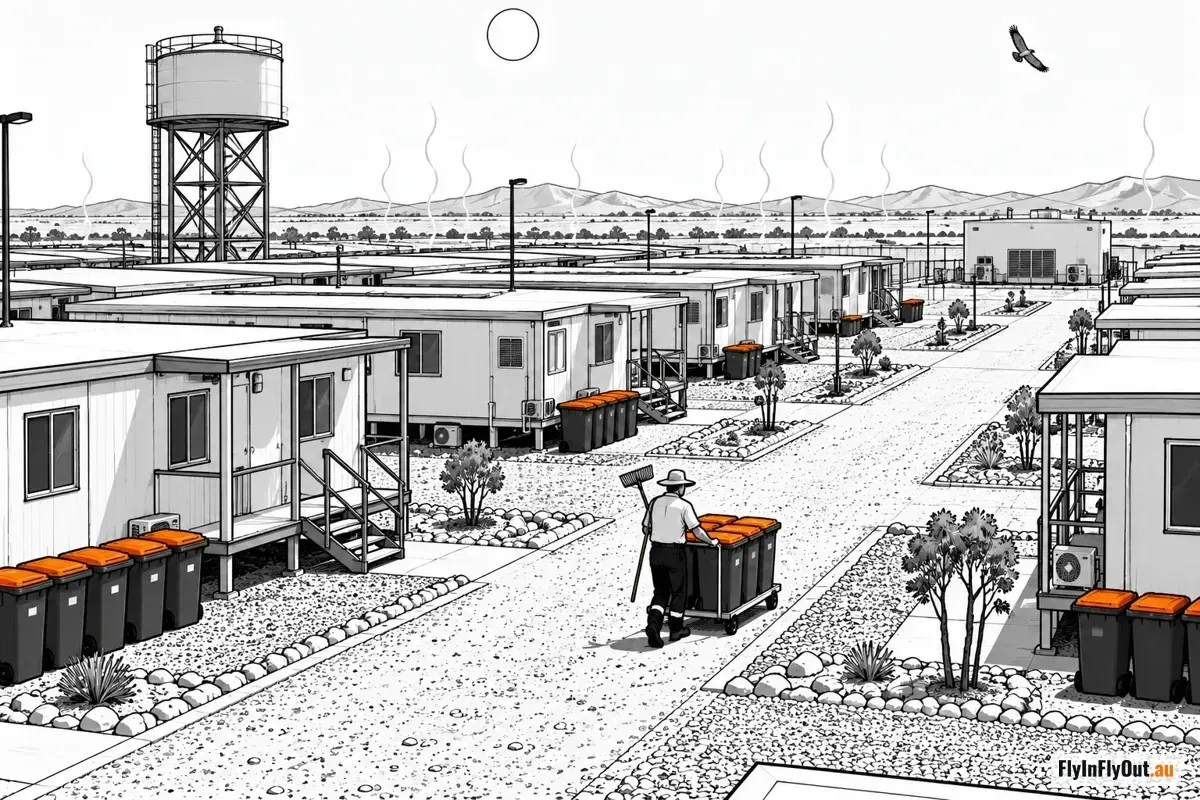
A fly in fly out camp is a small village built out near the mine. It has rooms, kitchens, bars and laundries, and everybody who works on that mine sleeps and eats there.
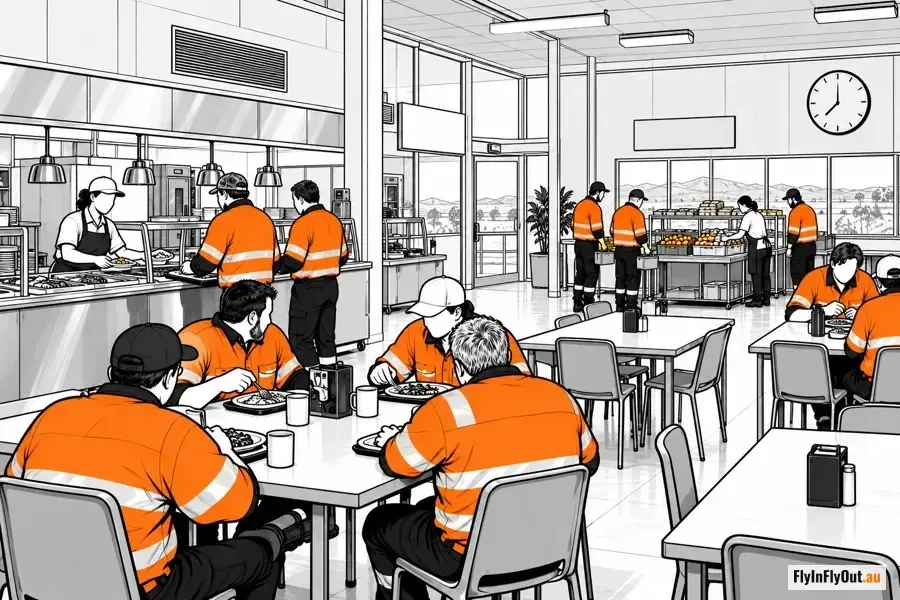
Your day in it starts at four in the morning, or half past four, depending on the site and on whether they've put you on breakfast. If you're on breakfast, you're in the dry mess before anyone else is awake. It's the dining hall, and it's called dry because no alcohol is served in it. You set it up, then you run the dish pit while a few hundred people eat inside ninety minutes.
You also keep the crib room stocked. Crib means a few things on site: the meal break, the food you take out on shift, and the room where you make it up. The room is the one that matters to you. Workers build their own crib there from the bread, cold meat, fruit and wraps you've put out, and if the wraps run out at ten past five in the morning, that's a problem with your name on it.
Housekeeping, the bulk of the day
After breakfast you usually move on to housekeeping, which is the bulk of most swings. A swing is the block of days you spend on site before you fly home, normally fourteen. Housekeeping means servicing the rooms, and the rooms are called dongas: single prefabricated rooms with their own ensuite, and everybody on site lives in one.
The ads say fifteen to twenty-plus rooms a shift. In each room you strip the bed, remake it, do the ensuite, wipe everything down and restock it, then you move on to the next one. Experienced housekeepers tell new ones to double-glove for the bathroom and for whatever's in the bin, and they say it as a rule, not as advice.
The laundry and the pot wash
The laundry and the pot wash are the hottest places on the camp. Think about it this way. Industrial machines run all day inside a demountable building, in a part of the country that spends summer above forty degrees, and the air conditioning usually isn't working.
One worker who lasted a year at it wrote online about hours at a time in a pot wash at 60 degrees and full humidity, with air conditioning that never worked.
Another wrote about a gap year as a kitchen hand and cleaner in the mining boom. It was bloody hard, mostly split shifts of twelve hours or more between 4am and 9pm on a two-weeks-on, one-week-off roster. The kitchen had next to no air conditioning, so the carrots got peeled sitting in the cool room, for relief.
Grounds and the wet mess
Grounds work is the outdoor side of the camp. You empty the bins, keep the gardens, sweep, do the rubbish runs and handle small repairs.
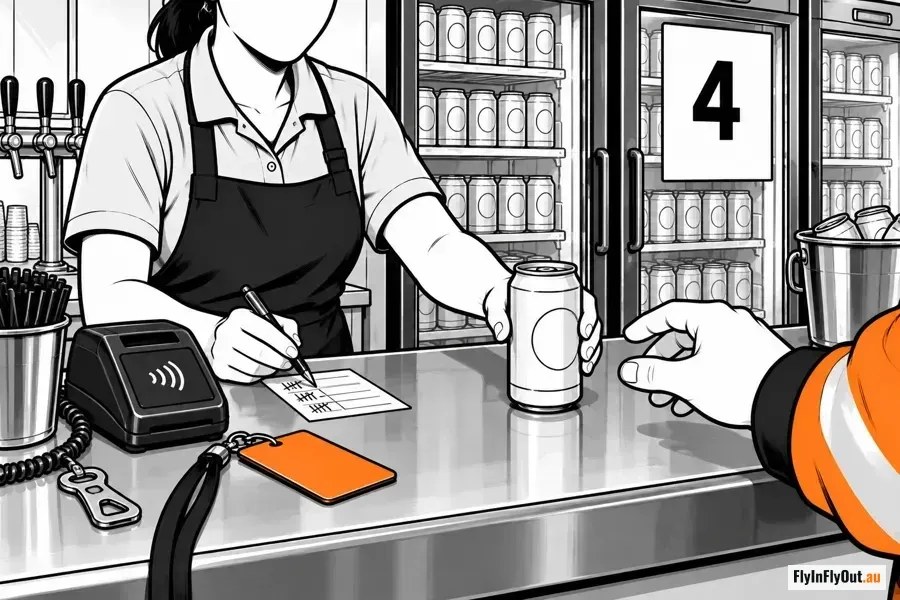
The wet mess is a different kind of shift. It's the camp bar. You serve drinks under strict limits, run the camp store, restock the vending machines and handle check-ins. Everyone wants the wet mess, and it goes to whoever holds an RSA, so it's worth having one before you arrive rather than after.
At the end of a shift you go back to your room and catch some sleep, ready to do the same again the next day. On a fourteen-day swing, that's fourteen of them before you see an airport.
The part that isn't in the ad
Working in a utility job isn't hard the way drilling is hard. It's hard because you're doing the same uninteresting thing on the ninth day running, in heat that doesn't let up, with your back starting to ache and five days still to go. Nothing about tomorrow is going to be different from today.
A physical job with some variety in it will hold most people. A utility job holds the ones who can switch off and keep moving. If that isn't you, offsiding for a driller is harder work and pays more, and it may suit you better.
The ads barely mention the night shifts, usually in a line like "days and nights". Flipping your sleep twice in a fortnight is a bigger ask than it looks, and it's the thing new starters most often say nobody warned them about.
What is it really like being a FIFO utility?
Short answer
Being a FIFO utility means doing one of the lowest-paid jobs in a camp where everyone knows roughly what everyone else earns. The ones who leave go because of the repetition, the heat, being looked through, and the loneliness of a crowded camp with nothing to do at night. It is rarely the cleaning.
Cleaning up after people making more money than you
Cleaning up after people on more money is part of every shift. A trade on that site is on far more than you, and the bloke whose room you cleaned this morning might be a diesel fitter. You made his bed and you scrubbed his shower. Tonight you'll walk past his table carrying a tub of dirty plates and chances are, he won't know you exist.
Most crews are decent about it. Plenty of blokes say good morning, learn your name and leave the room tidy, because they know who cleans it. One worker wrote online about his dad's advice before his first swing: never piss off the people who cook for you, clean up after you or book your flights home. One day you'll need a favour, and they're far more likely to help if they know you and like you.
Then there are the ones who look straight through you. They wear on a utility more than the hours do, and there's no way of knowing in advance which sort of site you're flying to. It comes down to the crew and the supervisor, and both of those change.
The wet mess, and how long people last
The wet mess has its own version of the divide. On some sites the utilities drink there with everybody else. On others they're staff rather than residents, and that splits the only social room in the place down the middle.
Some people last one swing, some last three, and some settle in and stay for years. The ones who stay are nearly always the ones who worked out early what they came there to get. For most people the one good reason to take the job is what it leads to.
Is a FIFO utility job a foot in the door?
Short answer
A FIFO utility job is one of the most common ways into mining for someone starting out. It gives you the two things no application from home can: a site induction on your record and a supervisor who has watched you work for six months. The usual path runs six to twelve months from utility into trade assistant, driller's offsider, field technician or a trainee seat on a truck.
Site experience and a reference
Once you've been through the induction, passed the medical and the drug test, and lived on a swing roster without quitting, you stop being a greenie. What's a greenie? It's what a site calls someone who's never worked on one before.
Think about it from the next employer's side. They aren't worried about whether you can work. They're worried about whether you'll still be there in week three, and you've already proved that.
A supervisor who knows your name
The second thing you get is the supervisor. A reference from inside the industry counts for a lot more than a reference from a cafe, and the person writing yours is standing twenty metres from the people who hire trade assistants.
A worker on a forum put it plainly: utility is a foot in the door, but not a pretty one, with pay near the bottom of the site and some truly horrible bosses. Once you're there, though, you hear about the openings on site and with the other subcontractors, and that's how people get in with one of them.
How people move up from fly in fly out utility work
Moving up from utility is not a promotion anybody hands you. You go and get it. You ask the crews whose rooms you clean how they got in, you pick up whatever tickets you're missing, and you apply for the next job from inside the gate instead of from a kitchen table at home.
The women's page has the far end of that path. A cleaner worked out how the camp contracts worked, went after one against her own employer, and won.
Stay in utility and the pay in year five is the same as in year one. That's fine if the roster suits your life, and a trap if you wanted more.
Is a FIFO utility job right for you?
Two honest questions
Being a hard worker isn't the question. Everybody thinks they're a hard worker, most of them are right, and it doesn't predict who lasts out there.
- Can you do a boring thing properly on day nine? Day one is easy, because it's new and you're paying attention, and so is day fourteen, when you can practically see the plane. Day nine is the actual job, and the only person who'll ever know whether you did the corners is you.
- Can you be invisible for six months without it souring you? You'll be making beds for people on much bigger pay packets, and some of them won't acknowledge you. If that turns into a grievance you carry into every shift, it will show, and it'll be the reason your supervisor doesn't put your name forward for the next thing.
Go in knowing what the job is for, and the boring days have something underneath them. Go in for the money on its own and you'll be counting hours by the Wednesday of your second swing.
Ready to look?
If you've read this far and still want in, the jobs are here. Get your paperwork sorted before you apply.
- Utility jobs in Perth on SEEK (opens in a new tab)
- FIFO utility jobs in Western Australia on Jora (opens in a new tab)
- Utility jobs in Perth on Indeed (opens in a new tab)
- All job boards, contractors and agencies in one list
Fake ads turn up on real job boards too. An ad that asks you to pay a fee before you start is a warning sign: report it to Scamwatch (opens in a new tab).
The job is one question. Whether the life suits you is six more. Three minutes. Free.
Is FIFO right for me?