FIFO Nursing Jobs
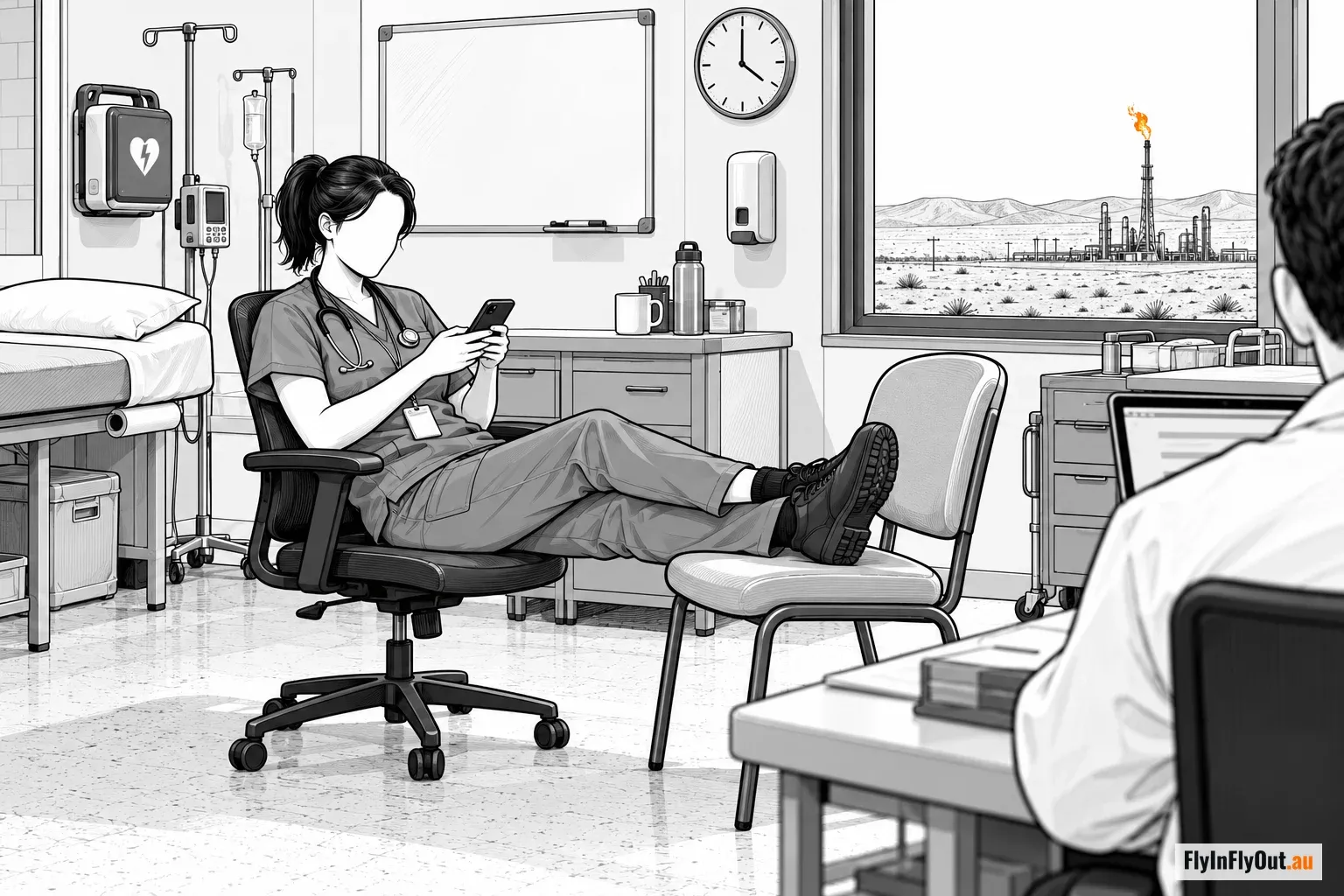
One nurse with sixteen years in FIFO posted about day five of a fourteen-day swing on a gas plant. There were two flu shots, one medical, and nobody else through the door in twelve hours; the doctor watched Netflix and she did the online shopping. She called it boring as shit. If that's you, the catch is the other kind of day: a crush injury at two in the morning, the nearest hospital hours away, and nobody behind you. You're paid for that day, not for the flu shots.
What a FIFO nurse is
A FIFO nurse is a registered nurse who flies to a remote mine, gas plant or community clinic for an eight to fourteen-day swing and runs its health post. The work is occupational health and primary care for the workforce, with the site's emergency response on top. The job exists in two forms, mine site nurse and remote area nurse, which are hired, paid and lived differently.
FIFO nursing jobs: Where to start
- Registered nurse with two years in emergency, intensive care or remoteStart here
- New graduate or ward nurseStart here
- Enrolled nurse, paramedic or medicStart here
- Nurse registered overseasStart here
- Want the pay, mine site against remote clinicStart here
- Want to know what the days are likeStart here
Find FIFO nursing jobs
SEEK listed 855 FIFO nurse jobs across Australia in October 2026. The ads are on SEEK (opens in a new tab), Indeed (opens in a new tab) and Jora (opens in a new tab). The titles vary, so search remote area nurse, site nurse, occupational health nurse, site medic and emergency services officer as well.
Before you apply, check where each ad's flights leave from, called the point of hire. Getting there is usually up to you.
FIFO nursing jobs at a glance
| Pay | Mine site: $69 to $85 an hour, or $156,000 to $163,000 a year salaried. Remote area nurse, on contract: $60 to $130.12 an hour |
|---|---|
| Rosters | Even time on most sites: 8:6, 7:7 or 2:2; 12:9 on some clinics; twelve-hour days, often day shift with on-call at night |
| Flies from | Perth for most mine sites; Broome, Darwin and Perth for the Kimberley and Northern Territory clinics |
| You'll need | AHPRA (Australian Health Practitioner Regulation Agency) registration, ALS (advanced life support), manual licence, police clearance; White Card on mine sites |
| Experience | Two to five years after registration, in emergency, intensive care or remote nursing |
| Who hires | Medical contractors and nursing agencies; Aboriginal health services for the clinics; a few miners direct |
Pay from the job ads of 12 October 2026. Listings checked October 2026.
Can you do FIFO as a nurse?
Short answer
You can get a FIFO job as a registered nurse with two or more years of acute care behind you, in an emergency department, intensive care or a remote clinic. Agencies turn away new graduates and ward nurses, because the site nurse works alone and the ads say so.
Why new graduates are turned away
In a city emergency department there is a registrar behind you, a consultant behind them and a resus team down the corridor. On a mine site there is you, maybe an emergency services officer, maybe a doctor on a screen. If you can't cannulate under pressure, read an ECG (a heart trace) alone and make a call at 2am with nobody to ask, the site will find that out on the night someone's life depends on it.
The way around it is the two years, and the ads name which two years count: emergency, intensive care, resus or a rural hospital. A rural or remote hospital post gets you both the experience and the kind of reference a site agency reads first.
FIFO medical jobs for enrolled nurses, paramedics and medics
The nurse's job at a mine asks for a registered nurse, because of the scope of practice and the drugs. Enrolled nurses and paramedics get on site through the other door: the emergency response ticket (a Certificate III), and a job as a site medic or emergency services officer, which the ads pay at $75 to $90 an hour. From there, plenty move into the clinic on the next contract. Physiotherapists get on site another way, through the occupational health providers that look after a mine's injuries (FIFO physio jobs).
Nurses registered overseas
An overseas nurse needs AHPRA registration and the right to work before any site agency will read the application, and the agencies don't recruit from overseas for these roles. Get registered, get a year in an Australian emergency department or regional hospital, then apply. The foreigners page covers the visa side.
How do you get a FIFO nursing job in Australia?
Short answer
You get a FIFO nursing job by applying to the agencies with your certificates already current, and to several at once, because each one staffs different sites. An application to the mining company goes nowhere; it contracts the health post out. Decide first which of the two jobs you're applying for, because the ads look alike and the pay doesn't.
Step by step, as a registered nurse in WA
- Build two years of acute nursing first, in emergency, resus, a rural hospital or intensive care (why new graduates are turned away).
- Decide which job you're after, the mine site clinic or a remote community clinic, because they're hired and paid differently (the two jobs).
- Get your tickets current: advanced life support, cannulation, a manual car licence and a police clearance, and for the mine sites the certificate to run drug and alcohol tests and a White Card (what the ads ask for). Every course asks for your USI (Unique Student Identifier), a free number you make online.
- Live near Perth Airport if you want the mine sites (where the jobs fly from).
- Register with several nursing agencies and medical contractors, with your résumé leading on your acute years (the résumé).
- Before you accept, check the hourly rate against the on-call hours that come with it (contract rate against penalties).
- Once you're offered the job, the employer books the pre-employment medical and the site inductions.
- On your first swing, expect medicals and walk-ins by day, calls by phone at night, and quiet days spent checking the rescue gear (a typical day).
For the remote clinics, or in Queensland
For a remote area job up north, the agency flies you to its hub, such as Broome or Darwin, and a four-wheel-drive course helps on the dirt roads. In Queensland, a handful of mine site ads hire from Brisbane (the hubs).
Mine site nurse or remote area nurse
Two different jobs go by the name FIFO nurse. A mine site nurse runs the clinic at a camp for a workforce of fit adults. A remote area nurse runs a community clinic in the Kimberley or the Territory: primary care for a whole town, on call after hours, often the only clinician for a long way.
The remote area ads carry the higher hourly rates and the penalties; the mine site ads carry the contract rate and the quieter days. Many of the ads with a dollar figure are for remote area nurses, so read the title before you read the number.
What the ads ask for
Most ads ask for:
- Unrestricted registration with AHPRA
- Advanced Life Support, or advanced first aid, ALS1 or ALS2
- Cannulation, and the confidence to work alone on nights
- A manual driver's licence and a national police clearance
- On mine sites, a White Card and a drug and alcohol tester certificate (HLTPAT005, now HLTPAT010)
After the offer, the employer arranges:
- A pre-employment medical, with its screening tests
- Site inductions
Nice to have, and what each one gets you:
- A Certificate III in Emergency Response and Rescue: a place on the rescue team, not just the clinic
- 4WD training: the remote clinic jobs, where the roads are dirt
- An immunisation endorsement: the flu and vaccine programs on site
Where to do the courses in Perth
Book an advanced life support course run under the Australian Resuscitation Council (ARC), which recognises its certificates for four years. ARC warns that some centres sell other courses that may not meet your employer's requirements, so look for "ARC" in the course name. ARC aims the two-day ALS2 at nurses from critical care, such as emergency or intensive care, and suggests the one-day ALS1 for other nurses.
| Course | Price, in the provider's words | Source |
|---|---|---|
| ALS1, advanced life support level 1, 1 day | $695 | St John WA, Belmont, Oct 2026 |
| ALS2, advanced life support level 2, 2 days | $1,795.00 AUD, for the course marked ARC | Parasol EMT, Perth, Oct 2026 |
| Advanced first aid (HLTAID014), online and in class, 5 hours | $189 | First Aid Pro, Perth, Oct 2026 |
| Drug and alcohol specimen collection (HLTPAT010), 1 day | $550 on sale, usually $650 | Progressive Diagnostics, Bentley, Henderson or Joondalup, Oct 2026 |
| HLTPAT010 online, with the practical on a video call | $650 | Alcolizer Technology, Oct 2026 |
HLTPAT010 replaced HLTPAT005, the code some ads still name, in December 2025, and it covers urine, oral fluid and breath testing. Alcolizer's online course needs an approved breath tester for the practical.
Where FIFO nursing jobs fly from: Perth, WA and Queensland (QLD)
Most mine site nursing ads fly from Perth and assume you live near the airport, while a clinic contract pays your flight to its hub as well as the charter, and puts you up between contracts. A few ads fly from Brisbane for Queensland sites.
How much does a FIFO nurse earn in Australia?
Short answer
FIFO nurses at mines were advertised at $69 to $85 an hour as contractors in October 2026, or $156,000 to $163,000 a year on salary. Remote area nurses were advertised at $60 to $130.12 an hour on contract, plus penalties and on-call. The annual figure is high because the swing is twelve-hour days.
| Role | Advertised pay | Source |
|---|---|---|
| Mine site nurse or paramedic, lowest hourly ad | Up to $69 p.h. | SEEK, MSS Security, October 2026 |
| Mine site nurse or paramedic, highest hourly ad | Up to $85p/h | SEEK, Redstone Recruitment, October 2026 |
| Mine site nurse or paramedic, salaried ad | $156,000 – $163,000 per year | SEEK, Risk 2 Solution, October 2026 |
| Remote area nurse, lowest hourly ad | $60-$120ph | SEEK, Limelight People, October 2026 |
| Remote area nurse, highest hourly ad | $110 – $130.12 per hour | SEEK, Prodigy Health Solutions, October 2026 |
Mine site nurse or paramedic: the bottom and top ad of each kind, from 4 job ads of 12 October 2026. Remote area nurse: the bottom and top ad of each kind, from 7 job ads of 12 October 2026; the middle hourly figure is $110 an hour. Only ads that stated a figure are in the table. Most don't.
To see what any of those rates comes to after tax, over a swing or a year, put it into the FIFO pay calculator.
Contract rate against penalties
Nurses looking at a mine site's hourly rate see a number they can beat on a Saturday night shift in the city, and on that shift they can. The contract rate wins over a year for two reasons the hourly figure hides. An 8:6 roster, eight days on and six off, means eight twelve-hour days, twenty-six times a year, which is close to 2,500 hours; a 38-hour city week is 1,976. And on site there is nothing to spend it on, because the room, the meals and the flights are the employer's.
If the figure on an ad is above $90 an hour, read the on-call clause before the rate. That's where the remote area money comes from, and where the nights go.
What do FIFO nurses do?
A typical day for a FIFO nurse
The clinic opens before the day shift goes out. New starters come in for pre-employment medicals: hearing test, lung function, blood pressure and the drug and alcohol screen. Then the walk-ins arrive: a dressing, a rash, a sore back, a bloke who hasn't slept, a crew leader who wants a certificate. There's a saying for the case mix: coughs, colds and sore holes, or major trauma, and not much in between.
A fair share of the day is the compliance machinery that keeps the site's licence: random testing, the records, the audits. If the words "drug and alcohol testing" in an ad bother you, weigh that before you apply, because on some sites it's half the job. On the quiet days, which are most days, the nurse checks the rescue gear, the fire equipment and the ambulance.
The day that isn't typical
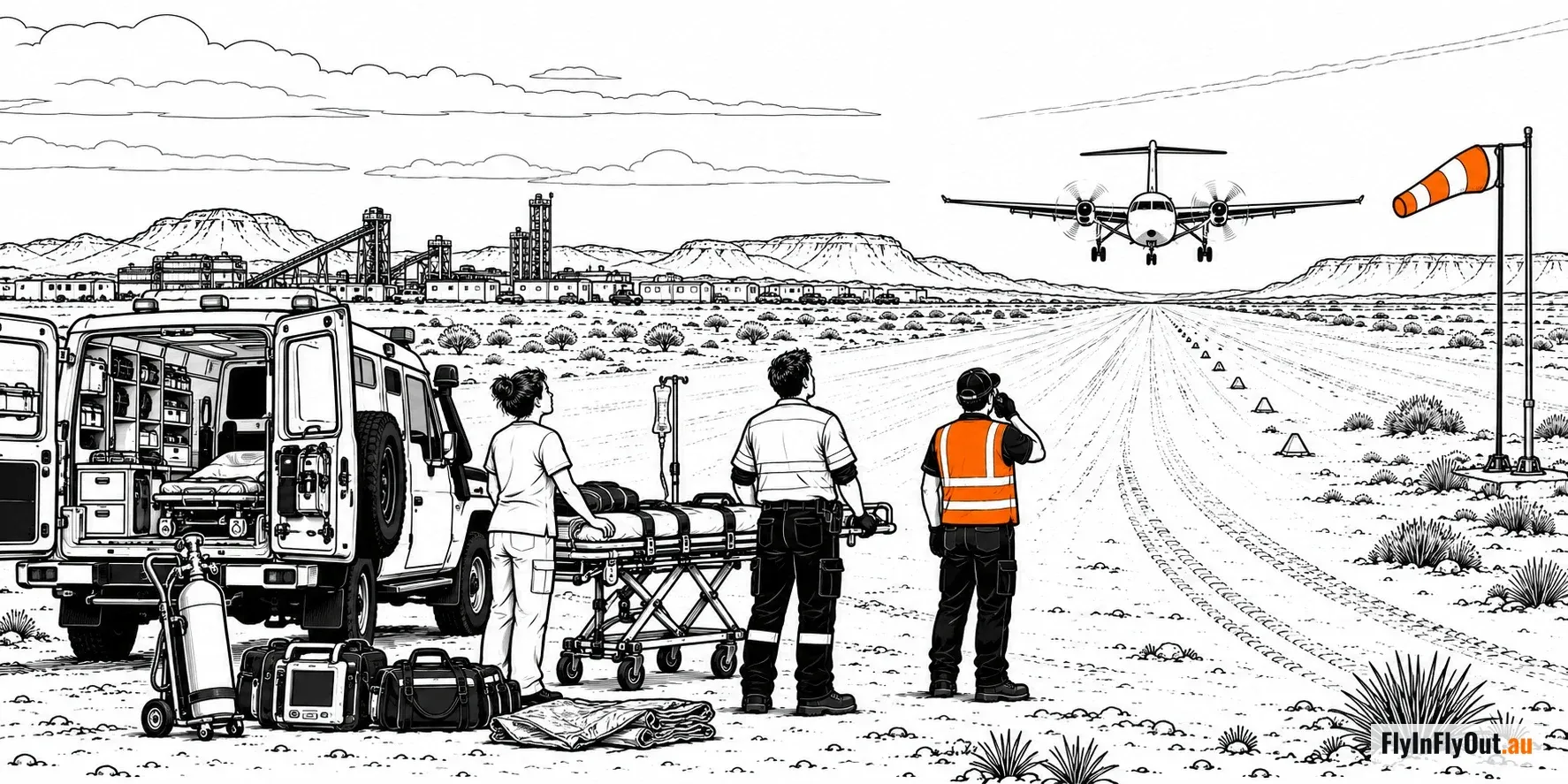
The bad days bring a chest pain, a fall from height, a hand in a conveyor, or a man who hasn't spoken to anyone for eleven days. There is no resus button. The nurse stabilises, gets a doctor on the screen if the site has one, calls the Royal Flying Doctor Service, and waits, because the plane flies on the weather's timetable and the strip may or may not be usable. One site nurse summed up the job in a video: don't go there to sit around doing nothing, because when things go wrong, it's on you.
The hours are twelve a day for the swing. Many mine sites keep the nurse on days and on the phone at night, with a paramedic or medic covering the rest.
What is it really like being a FIFO nurse?
Short answer
Being a FIFO nurse means your patients are the people you eat with, and there is no wall between the clinic and your dinner table. The contractor who employs you answers to the mine, so a decision to send someone off site is reviewed by people who aren't clinicians. Most who leave go because of the isolation, not the work.
You live with your patients
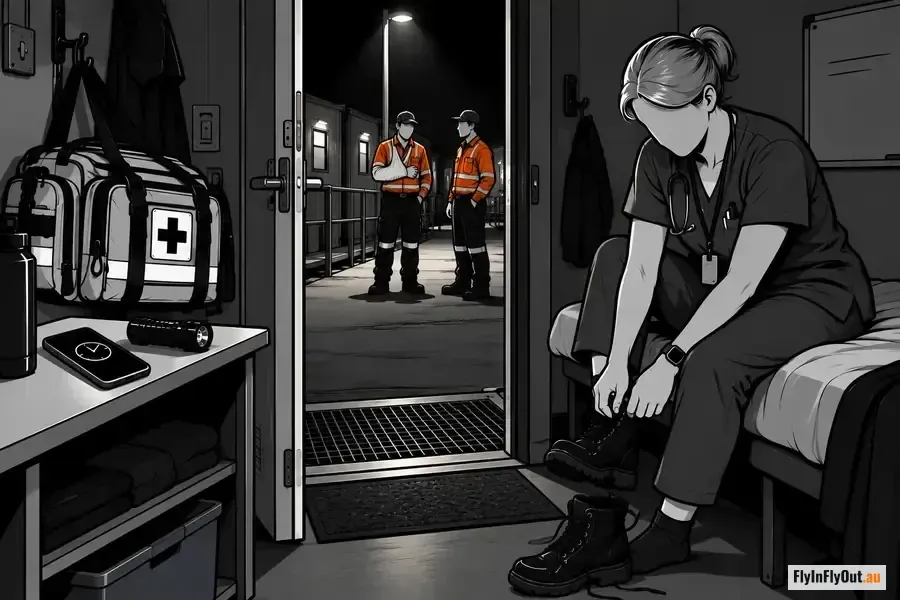
In a city hospital you treat a patient, hand over and go home; the two lives have different buildings. On site the wall is gone.
You dress a bloke's burns, then eat across from him in the mess. You talk someone through a terrible afternoon, then sit next to him on the bus to the airstrip. You coordinate a mate's evacuation and his crew knows at breakfast, and nobody quite knows what to say.
The donga door can be knocked at any hour, and the next day's clinic opens whether you slept or not. Contracted nurses also describe the scrutiny: sending a worker off site in an ambulance needs a manager's sign-off, and if the paperwork isn't perfect the nurse is the one standing in the review.
Why they stay anyway
The nurses who describe FIFO as the move that saved their career came from double shifts, overcrowding and ward politics on public wages. On a well-resourced site they work alongside a paramedic or a doctor, see a fraction of a hospital's patient load, and go home for six days or two weeks with the mortgage shrinking. The money gets them on the plane. The time off is what keeps them.
Clinicians are often slow to ask for the help they hand out. If a swing turns bad, Nurse and Midwife Support 1800 667 877 is confidential and open all hours, and Lifeline 13 11 14 is there too. The mental health page is written for the person who isn't sure it's bad enough to call.
Where does FIFO nursing lead?
Short answer
FIFO nursing leads to remote area nursing, offshore work, emergency services and, for some, a permanent job with a mining company rather than a contractor. A direct hire with a miner adds leave, a higher super rate and a bonus to the package, which the contractor's flat rate doesn't carry.
After a few swings the agency rings you instead of the other way round, and a site asks for you by name. A nurse who adds the emergency services ticket can run a site's rescue response as well as its clinic, which is the combination the miners want on their own payroll. The women's page has the far end of the nursing path.
Is a FIFO nursing job right for you?
Two honest questions
The question isn't whether you're a good nurse; the agencies have already checked that.
- Can you make the call in the middle of the night with no one to escalate to? You'll be making it in the dark, alone, with a patient who needs an answer now and a plane that's two hours out.
- Can you check the ambulance on the ninth quiet day as if it were the first? The pay is for readiness, and readiness is a habit that boredom eats. The nurse who skipped the check is the one the review finds.
Ready to look?
If you've read this far and still want in, the jobs are here. Have your registration, ALS and police clearance current before you apply, and send it to more than one agency.
- FIFO nurse jobs on SEEK (opens in a new tab)
- FIFO nurse jobs on Indeed (opens in a new tab)
- FIFO nurse jobs on Jora (opens in a new tab)
- All job boards, contractors and agencies in one list
Fake ads turn up on real job boards too. An ad that asks you to pay a fee before you start is a warning sign: report it to Scamwatch (opens in a new tab).
The job is one question. Whether the life suits you is six more. Three minutes. Free.
Is FIFO right for me?