FIFO Salary

The FIFO pay figure people quote is usually a yearly number, and the yearly number is the least useful one there is. It hides the hours, it hides whether the flights and the room are in it, and it hides what's left after tax. So these figures come from the job ads themselves, taken down on a single day, with the hours worked out underneath, and you can see what an ad is really offering before you apply.
What a FIFO salary is
A FIFO salary is what a fly-in fly-out job pays for a year of swings, an hourly rate or a yearly figure, with flights and camp on top. The yearly figure is high because a 2:1 roster, two weeks on and one off, works far more hours than a city job. Divided by those hours, most FIFO jobs pay a good rate rather than a remarkable one.
FIFO salary: Where to start
- What does my job pay?Start here
- Got an ad, want the real hourly rateStart here
- Casual rate or a salary?Start here
- Tax timeStart here
- Comparing it with my city jobStart here
- Want to run my own numbersStart here
Find FIFO pay rates
The ads that state a figure are on SEEK (opens in a new tab), Indeed (opens in a new tab) and Jora (opens in a new tab); most don't, so filter by salary where the board lets you. Put any rate you find into the calculator for the swing, the year and the take-home.
Before you apply, check where each ad's flights leave from, called the point of hire. Getting there is usually up to you.
FIFO salary at a glance
| Middle ads | $232,000 (electrician) down to $101,000 (cleaner or housekeeper), the middle ad as a 2:1 year, October 2026 |
|---|---|
| Hours a year | 2,920 on a 2:1 roster; about 2,503 on 8:6; 2,190 on 7:7; 1,976 in a 38-hour city week |
| On top | Charter flights, a donga and three meals a day on site, and 12% super unless the figure is a "package" |
| Take-home | $88,408 a year on the camp utility middle rate, $162,968 on the electrician's, on 2:1 at 2026-27 rates |
| Tax | The same rates as any resident; no claim for getting yourself to the airport; no zone offset from a city address |
| Casual or salary | Casual rates are higher and carry no paid leave; a salary is lower per hour and brings leave |
Pay figures from 249 ads on SEEK, Jora and Indeed, read 12 October 2026; take-home from the calculator.
How much do FIFO workers earn?
Short answer
FIFO workers in Australia were advertised at $101,000 a year as a cleaner or housekeeper up to $232,000 as an electrician in October 2026. Each figure is the job's middle ad worked out as a 2:1 year, and nobody publishes an official FIFO average. The averages online have no source you can check; the chart's 249 ads for 20 jobs were all read the same day.
Page one of Google will give you an average FIFO salary to the dollar, and no two pages give the same one, because there is nothing to average. There is no register of FIFO workers and no award called FIFO; there are camp cleaners, sparkies and truck operators on the same plane, paid three different ways. So the honest answer to "how much does FIFO pay" is a chart, not a number: what each job's ads were offering, with the middle ad marked on each.
FIFO pay by job, October 2026
Lowest ad to highest, as a year Middle ad
- Electricianmiddle $232,000, $120,000 to $307,000
20 ads · Work out the take-home (electrician)
- Boilermaker or weldermiddle $208,000, $175,000 to $248,000
- Mechanical or heavy diesel fittermiddle $207,000, $175,000 to $301,000
20 ads · Work out the take-home (mechanical or heavy diesel fitter)
- Mine site nurse or paramedic$156,000 to $248,000
4 ads, too few for a middle figure · Work out the take-home (mine site nurse or paramedic)
- Riggermiddle $194,000, $152,000 to $313,000
17 ads · Work out the take-home (rigger)
- Plumbermiddle $187,000, $120,000 to $204,000
19 ads · Work out the take-home (plumber)
- Truck or plant operatormiddle $183,000, $131,000 to $263,000
- Carpentermiddle $176,000, $120,000 to $204,000
14 ads · Work out the take-home (carpenter)
- Storepersonmiddle $161,000, $115,000 to $185,000
- Trade assistantmiddle $155,000, $131,000 to $166,000
- Site administratormiddle $149,000, $102,000 to $161,000
- Driller's offsidermiddle $130,000, $105,000 to $190,000
- Trainee operatormiddle $126,000, $111,000 to $145,000
5 ads · Work out the take-home (trainee operator) Most trainee operator ads were for people living near the mine (Hunter Valley, Mudgee, Central Queensland), not FIFO. They're kept because they show what a trainee is paid.
- Security officer$87,000 to $161,000
3 ads, too few for a middle figure · Work out the take-home (security officer)
- Bus drivermiddle $112,000, $98,000 to $145,000
- Camp utilitymiddle $112,000, $76,000 to $146,000
- Cook or chefmiddle $108,000, $86,000 to $204,000
- Cleaner or housekeepermiddle $101,000, $69,000 to $184,000
The advertised figures, before they're turned into a year
| Job | Hourly ads | Salaried ads | Ads |
|---|---|---|---|
| Electrician | $60 to $105, middle $83.25 | $120,000 to $151,950 | 20 |
| Boilermaker or welder | $60 to $85, middle $71.25 | $184,576 to $232,960 | 20 |
| Mechanical or heavy diesel fitter | $60 to $103, middle $72 | $180,000 to $190,000 | 20 |
| Mine site nurse or paramedic | $69 to $85 | $156,000 to $163,000 | 4 |
| Rigger | $52 to $107.21, middle $66.50 | None | 17 |
| Plumber | $50 to $70, middle $65 | $120,000 to $140,000 | 19 |
| Truck or plant operator | $45 to $90, middle $62.50 | None | 20 |
| Carpenter | $50 to $70, middle $60.50 | $120,000 to $150,000 | 14 |
| Storeperson | $42 to $63.46, middle $55.50 | $115,000 | 7 |
| Trade assistant | $45 to $57, middle $53 | None | 6 |
| Site administrator | $45 to $55, middle $52.50 | $101,500 to $101,911 | 10 |
| Driller's offsider | $36 to $56, middle $43 | $120,000 to $190,000, middle $130,000 | 18 |
| Trainee operator | $38 to $49.65, middle $43 | None | 5 |
| Security officer | $55 | $86,724 to $94,800 | 3 |
| Bus driver | $37.34 to $49.50 | $97,850 to $102,500 | 7 |
| Camp utility | $35 to $50, middle $39.75; day rates $458.53 | $76,138 to $95,000, middle $88,122 | 13 |
| Cook or chef | $43 to $70, middle $48; day rates $437.54 to $503.63 | $86,000 to $115,000, middle $100,050 | 20 |
| Cleaner or housekeeper | $33 to $63, middle $44.50 | $68,968 to $82,311, middle $76,503 | 12 |
| Apprentice | $14 to $35, middle $27.50 | None | 7 |
| Remote area nurse | $60 to $130.12, middle $110 | None | 7 |
FIFO salary with no experience
The entry jobs sit towards the bottom of the chart and still clear six figures over a 2:1 year: camp utility, cleaner, trainee operator, driller's offsider and trade assistant, all from the middle ad. Two things before you take those numbers home.
The camp jobs often run 2:1 and the offsider and trainee jobs vary, so the year depends on the roster you're offered. And twelve of the fourteen operator traineeships on SEEK in October 2026 wanted people already living near the mine. The no-experience page covers which door is open to you.
How is a FIFO salary worked out?
Short answer
A FIFO salary is worked out one of three ways: an hourly rate for every hour on site, a day rate for every shift, or a yearly salary. Super is on top unless the ad says "package" or "total", which means it's inside the figure. A casual rate is higher because it carries no paid leave.
The October 2026 ads use a few shapes, and they don't compare straight across. An hourly rate ("$65 - $80 p/h + Super paid on all hours worked") covers every hour you work, overtime included, and "flat" ("$56 flat p.h.") usually means the rate already covers nights and weekends. A day rate ("Daily pay rate: $503.63 + Super + Allowances") is one 12-hour shift.
A salary "+ super" is before super, and a "Total Salary Package" has it inside. The words after the figure, "+ Penalties", "+ Allowances", "+ P/H OT" (public holidays and overtime), are the parts that aren't in it yet.
Casual rate or salary
Fair Work's rule (opens in a new tab) is that a casual gets "a casual loading (a higher pay rate for being a casual employee)", and in return "casuals don't get most types of paid leave, notice of termination or redundancy pay". The chef ads show what that means. The middle salaried chef ad was $100,050 a year, which on a 2:1 roster is $34.26 for every hour worked, before tax; the middle casual chef ad was $48 an hour.
Which is better depends on whether you'll take the leave. The labour hire agencies mostly advertise the casual rate, and the mine owners and camp contractors the salary; how mining work is organised explains who is who.
Do FIFO workers get paid on their weeks off?
A FIFO worker on a salary is paid the same each pay period, on site or off. On an hourly or day rate, pay comes only for the hours or shifts worked, so the weeks off are unpaid.
How much is a FIFO salary per hour, per swing and per month?
Short answer
A FIFO salary per hour is the ad's rate; per swing it's that rate times 168 hours, for fourteen 12-hour days; per month it's a twelfth of the year, averaged. The middle camp utility ad, $39.75 an hour, is $6,678 a swing and $116,070 a year before tax on a 2:1 roster, $88,408 after it. The FIFO pay calculator does the sums for any rate and roster.
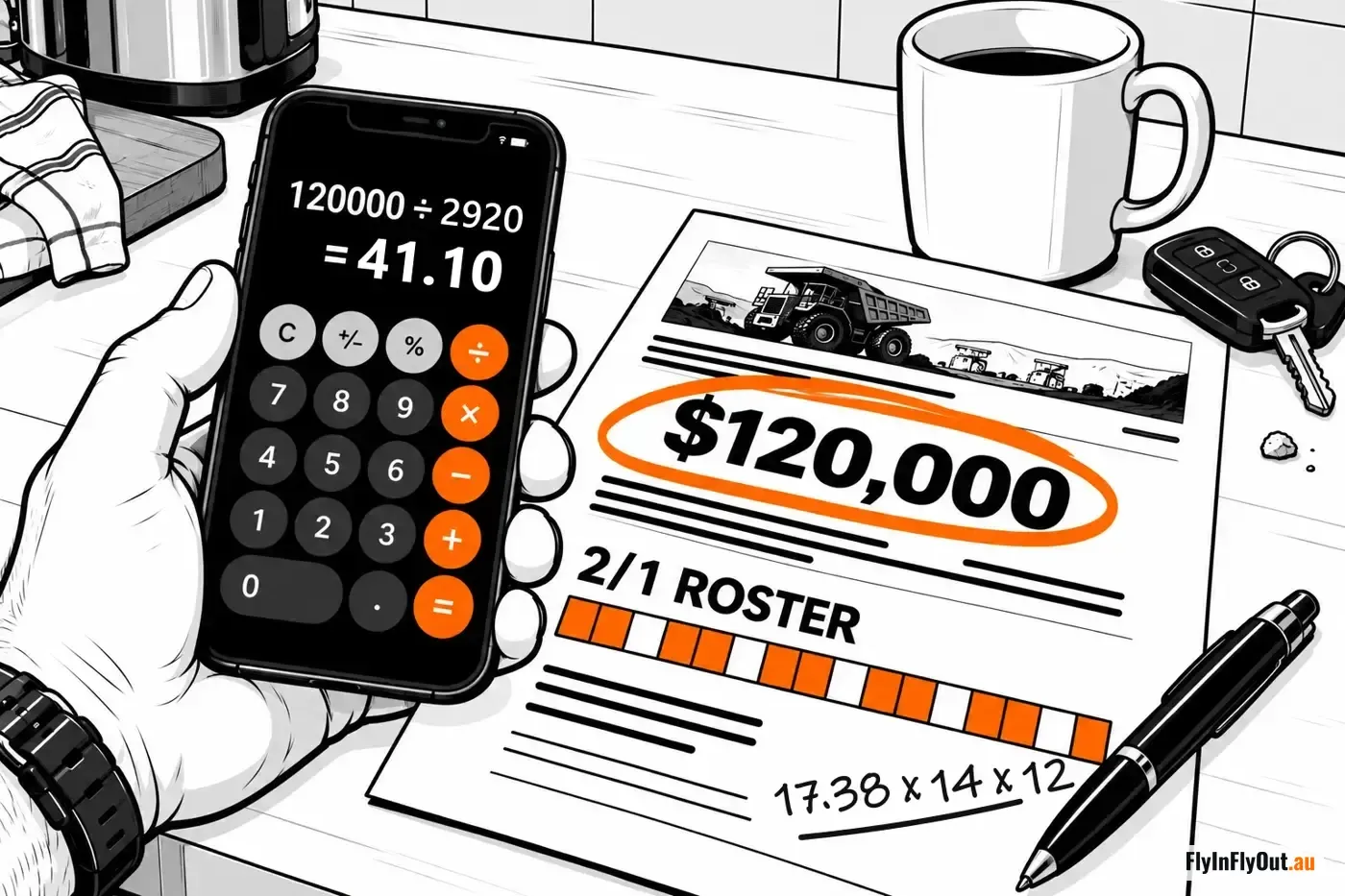
A 2:1 roster is 17.38 swings a year, each one 14 days of 12 hours, which is where 2,920 comes from. Divide any yearly figure by it and you have the hourly rate; multiply any hourly rate by it and you have the year. Here are the middle ads for four jobs through the calculator, before any overtime, allowance or bonus.
| Middle ad, 2:1 roster | Before tax: a swing, a year | Take-home a year |
|---|---|---|
| Camp utility, $39.75 an hour | $6,678 a swing; $116,070 a year | $88,408 |
| Driller's offsider, $43 an hour | $7,224 a swing; $125,560 a year | $94,861 |
| Truck or plant operator, $62.50 an hour | $10,500 a swing; $182,500 a year | $130,255 |
| Electrician, $83.25 an hour | $13,986 a swing; $243,090 a year | $162,968 |
Calculator results, October 2026; super is paid on top of each.
The roster moves the year more than the rate does. The same camp utility ad on a 7:7 roster (seven days on, seven off) is 2,190 hours and $87,053 before tax; the same operator ad on an 8:6 (eight on, six off) is about 2,503 hours and $156,429. A monthly figure is the year split twelve ways, so a month on site earns more than it and a month with two weeks at home less, and the roster has to sit beside it. The calculator takes your rate and your roster and gives the swing, the month and the pay after tax.
What does a FIFO salary include?
Short answer
A FIFO salary includes your flights to site, your room and meals there, and the employer's super on top of the figure. Overtime and allowances are usually extra, and the ad lists them after the pay.
The package is the part the yearly figure doesn't show. On site the room, three meals, the gym and the bus are paid for, so for two weeks in three you spend close to nothing. What that saves is your own sum, set by what the rent and the fridge cost at home.
The allowances sit outside the figure, and Sodexo's plumber ad, "$135,500 per year + P/H OT + Allowances + Super", is the pattern: a salary with the overtime paid hourly on top. Super is 12% of ordinary pay under the ATO's super guarantee, paid by the employer and not out of your rate.
What can FIFO workers claim on tax?
Short answer
FIFO workers can claim what any worker can: money spent to earn the income, not paid back, with a record to prove it. The trip to the airport is private travel, and a city address rules out the zone offset.
There is no FIFO tax. The ATO's rates for residents (opens in a new tab) in 2026-27 apply to a FIFO wage like any other, nothing on the first $18,200 and then 15%, 30%, 37% and 45% as the income climbs, plus the Medicare levy. What a FIFO worker can claim follows the ATO's guide for mining site employees (opens in a new tab) and its ruling on travel, checked October 2026.
FIFO worker tax deductions: what you can and can't claim
- Getting to your point of hire isn't claimable. The ATO's ruling TR 2021/1 (opens in a new tab) uses a FIFO worker who lives in Sydney and is rostered on at Perth airport as its example: the Sydney to Perth flights are private travel.
- Car trips to the airport are the same: "normal trips between your home and regular place of work" aren't deductible.
- Airport parking: the ATO's pages don't name it for FIFO workers either way, so ask a registered tax agent before you claim it.
- Overnight travel is claimable only when the job requires you to sleep away from home and you paid for it; the donga and the mess the employer provides are not a claim.
- Tools you buy for work that the employer doesn't supply: $300 or less in the year you buy them, more over the tool's life.
- The zone offset goes by where you live, not where you work. The ATO's words (opens in a new tab): "If your usual place of residence wasn't in a zone, you're not eligible."
- Living-away-from-home allowance (LAFHA): the ATO says a LAFHA is non-assessable and then that "circumstances may be different for fly in, fly out (FIFO) workers", so read the ATO's page (opens in a new tab) and take it to an agent.
Using a FIFO tax accountant
If you use a FIFO tax accountant, check they're on the Tax Practitioners Board's register (opens in a new tab), which also finds a registered agent near you, in Perth, Adelaide or anywhere else. The calculator gives the tax on any rate; the agent gives the deductions.
Is FIFO pay really higher than city pay?
Short answer
FIFO wages are higher than city pay by the year and closer by the hour. The middle driller's offsider ad, $43 an hour, is $125,560 a year on a 2:1 roster, and the city rate that matches it after tax is $63.54 an hour. The difference is 944 extra hours at work and nights in a donga.
A commenter in an online thread asking whether FIFO pay is truly great put it plainly: a healthy pay packet, but work out the hourly rate and it doesn't seem special, because it's 12-hour days, every day. The official figure points the same way. In the ABS's May 2026 earnings (opens in a new tab), full-time adults in mining earned $3,224.20 a week in ordinary time against $2,083.70 across all industries; that counts everyone in mining, not only FIFO workers, and leaves overtime out.
The calculator puts it per job: a city job would need $58.74 an hour to match the utility rate after tax, $92.36 the operator and $123.02 the electrician. The money is real, and it's bought with hours and nights away. Some people on it still end up broke, and whether FIFO is worth it for you depends on what the money is for.
Is a FIFO salary right for you?
Two honest questions
- Have you divided the year by the hours? Take the figure in the ad, divide by 2,920 for a 2:1 roster, and ask whether you'd do the job in town for that rate. If the answer is no, the roster is what you're being paid for.
- Casual or salary, and have you priced the leave? The casual rate looks better in the ad and the salary looks better the week you're sick. Decide which you are before you compare two offers.
Ready to look?
If you've got an offer or an ad in front of you, run it through the calculator with your roster, then look at what the rest of the board is paying for the same job.
- FIFO pay calculator: your rate, your roster, your take-home
- FIFO pay rates on SEEK (opens in a new tab)
- FIFO pay rates on Indeed (opens in a new tab)
- FIFO pay rates on Jora (opens in a new tab)
- All job boards, contractors and agencies in one list
Fake ads turn up on real job boards too. An ad that asks you to pay a fee before you start is a warning sign: report it to Scamwatch (opens in a new tab).
The money is one question. Whether the life suits you is six more. Three minutes. Free.
Is FIFO right for me?